Praxis: A Writing Center Journal • Vol. 23, No. 3 (2026)
Why Place Matters: Identifying Usage Patterns Based on Writing Center Location
Kimberly A. Bain
Palm Beach Atlantic University
bainka@pba.edu
Abstract
The campus writing center is a place of institutional vulnerability. With departmental budget cuts and restructures on many campuses, the value of writing center work within the institution is often challenged. While efforts to find value in this work, despite these challenges, are supported by theories of de-centered and borderless writing support, the value placed on physical space must be considered as intrinsic to writing center work. Because academic writing support operates in the ecology of the institution, the value of support outside of classroom instruction is often demonstrated through the designation of its physical space on campus. This article argues that reflecting value through the provision of physical, fixed space communicates to outsiders, not only to users of that space, but to the institution as a whole. Looking at one institution’s decision to hold writing center functions in a temporary space with limited borders and lack of close support to a fixed, designated space for writing support highlights its value through usage rates from one academic year to another. Providing this key insight into a case study of writing center effectiveness, one can consider how value and classification of the physical space affect the use of the center. If institutions are to value the center and the work done therein, they must be willing to provide adequate, designated space to reflect that value, so that outsiders can create positive associations and memory of writing support on campus.
Keywords: spatial rhetoric, program administration, decentering, public memory
Introduction
To examine place as an essential component of on-campus writing support—whether the place be a writing lab, studio, or conference room, is to evoke a rhetoric of importance. Making connections to who we are, what we do, and where we are is vital to the work we do as writing center professionals. The space that supports that work reflects the values of both the writers and the institution where it is located. In late fall of 2024, the writing center I direct at Palm Beach Atlantic University, Writing Central, moved to a permanent location on campus proximal to other academic services that reinforce its institutional value. Prior to this move, our writing center existed as two-to-three sets of portable tables, a few chairs, and a single desk. Our location: the corner of a hallway surrounded by computer labs. While this space was functional for the center’s most basic operational needs, it was truly “makeshift.” Through a close analysis of the usage data before and after Writing Central’s move from the hallway to a permanent location within the library—a nexus of academic support within our institution—I argue that proximal power exists when writing centers are located near familiar academic centers of support on campus, subsequently developing a rhetoric of value that encourages the existence of writing centers within institutions of higher learning. Genie N. Giaimo notes that “Space is not interchangeable, despite the neoliberal turn toward swing spaces, open spaces, and otherwise informal spaces. Space, like contingency, is also not value neutral” (36). In an effort to affirm the subjectivity of location and its weight on the perceived value of writing center work, this essay examines the data from Writing Central’s usage patterns before, during, and after the transition to our permanent location in our university library. By analyzing the center’s usage data, I argue that physical location signifies how much an institution values the writing center and how that value is communicated to the campus community.
Because of its often precarious position within institutions of higher learning, the writing center must assert the value of its physical location on the college campus: proximity communicates that value to the institution. On the importance of physical location in the perception of writing centers, Kara Wittman et al. point out that:
The physical space represents a place where we can find each other when everything feels scattered and far flung, and that has real value. Our space is modest, but we now know we can’t underestimate the value of being able to point to a space down a path, or in a hallway, or on a map, where a student can go and encounter other humans ready and willing to help, to talk, to listen.
Wittman et al.’s discussion of locality in writing center work resonated with me after experiencing the transitional periods of relocating Writing Central. As the director of Writing Central, I considered the concept of locality when the center existed temporarily in a hallway. The cramped space was far away from any identifiable connections to on-campus academic support. As a result, the value and presence of the writing center was compromised. As Hadfield et al. note, “Metaphors of home are also often used to describe writing centers with the proverbial coffee pot offering a welcoming cup… [resulting] in a space where people enjoy spending time and where they are happy, productive, creative, and social.” (170). However, home evokes a sense of familiarity that correlates with proximity, something not present when Writing Central was placed in a temporary location, away from other familiar academic points of support. As Morris notes, “In writing center lore, the space of the writing center is often emphasized: the closet, the basement, the shiny new location in the middle of campus. The physical space is an important one. That’s where connections are made and the space is where students are invited to return again and again” (178). If outsiders (i.e., individuals or groups unfamiliar with the work of a writing center) are able to classify the location of writing support as valuable and appropriately positioned with other centers of academic support, they can see how this value is reflected in the physical presence of the writing center as a noteworthy space of on-campus engagement. Assessing qualitative data of writing development and academic success are often measured by institutional administration to gauge the writing center’s value and justify its existence on campus. However, grades and academic progress measurements may not be the vital component that upholds the center in terms of sustainability and the reflection of that value through institutional funding. Rather, an essential metric of value is in the ability to provide connectivity that correlates with student retention while maintaining standards of academic excellence. The center’s usage rates often reflect the clearest distinction of value based on the ongoing support the center provides students, which is reinforced by repeated student engagement. I argue that these usage rates often involve key concepts of accessibility that are intrinsic to location and placement on campus.
Location classification, which sets academic support centers apart from classrooms, affects the support center’s usability as it is perceived not only by students, but also by faculty who support student usage of these resources. Peter Carino considers the classification of the classroom’s value compared to that of the writing center among students. He notes that “students so acculturated to tangible rewards—they speak of ‘getting something out of a class,’ ‘getting good grades’—may wonder what they ‘get out of’ going to the center, what they ‘get for’ spending an hour of their busy week talking with someone about their writing” (102). This perceived value does not only impact students, but also faculty and administration. The precarity of the writing center is demonstrated by the struggle to appropriate a classification for its use outside of the classroom. This misclassification can lead to shifting values placed on the work of the writing center. It may also mean that “Having felt the pressure of being on the bottom of hierarchical relationships in the university, centers have been loathe to take an authoritative position in their work, preferring a peer tutoring model that promotes a nonhierarchical relationship between tutor and student” (Carino 98). However, this non-hierarchical model can also create a “working” value that is placed onto the center, which leaves it out of important considerations of location and proximity on campus. Outsiders may perceive the writing center as fluid and unstable in nature, and seek to withhold tangible support for its location or become unwilling to develop its resources to position it connectively within the institution.
At Palm Beach Atlantic University, Writing Central’s staff is made entirely up of undergraduate and graduate peer coaches, whose employment structure is fluid. They are often employed on a contingent basis. While other academic support services such as the Testing Center and the Office of Accessibility have full-time, non-student staff that conduct operations, Writing Central is unique. Under the auspices of the university’s English department, services are performed entirely by peer coaches under the leadership of a faculty director and part-time coordinator. The structural fluidity of the center is often reflected in its physical proximity to other, more established locals of academic support. Even outside of the classroom-learning classification, the writing center is difficult to classify as a designated nexus of academic support, based on these structural peculiarities. Because of the uniqueness in departmental structure, writing centers often have to vie for a valued location in proximity to other academic support centers, rather than be defaulted as an embedded part of the university that physically anchors academic support. When students can not make these connections of value due to the location of the writing center, engagement falters. Similarly, much of the confusion surrounding the geography of Writing Central’s temporary location was in finding it on campus. Geographically removed from other academic support centers on campus, Writing Central was positioned in an in-between state, possibly as unsure in location as it was in support. Engaging in writing center support meant that students had to enter a now-secured building with their access card, discuss their writing support needs with a coach that may have been in close proximity with another coach and his student, and navigate the busy hallway of faculty office meetings and classroom sessions.
The argument for designating a distinct, fixed writing support location can be traced to the origins of institutional writing support within institutions of higher learning. During the early 20th century, designated writing support services grew as a pedagogical component of the writing classroom; after the end of the Cold War, writing labs emerged out of a turn toward formalism in education. (Boquet 471). Through the use of writing labs, on-campus writing support became a directive, pedagogical remedy for the struggling collegiate writer, later carving an identity for support through nondirective engagement fostered by personalized collaboration, less tied to curricular goals. Emphasizing extracurricular writing support services meant connections and associations with classroom learning needed to be distinct. The argument that the writing center needed to be more than just an extension of the classroom meant developing theories that identified the value of location as a place with its own identity.
In considering the rhetorical borders that continue to cultivate that value, Eric M. Camarillo notes the following:
Writing centers (and other sites of hegemonic privilege) tend to protect their borders, their boundaries, in order to prevent what might be viewed as chaos. A “center” necessarily centers bodies and discourses, normalizing them and flattening difference. (236)
As Camarillo notes, the bordering of writing support comes with particular spatial rhetorical moves. Becoming distinct from that of a directed, learning classroom or a laboratory for classroom remediation means providing a defined location to cultivate close connections with writers and their coaches as they work through challenges and considerations of the writing process as a valued nexus of learning support. These rhetorical moves support the argument for distinct learning support within the institution and outside of the classroom, which still maintains standards of excellence offered through close, nondirective environments of learning.
As a director, I am committed to the promotion of writing center excellence by offering rigorous training programs and resources that fully support student writers. Working out of a suitable location considers another dimension of “excellence”: outsiders identify the work done in the writing center with supportive work done elsewhere on campus.
The academic writing center often carries with it perceptions of questionable value, which are often demonstrated through defunding, resource removal, and staff reduction. For many academic institutions, quantitative data is often used to assess the writing center’s validity as an on-campus resource. The reality for many writing center practitioners (Cirillo-McCarthy et al.) is that this work is essential to reflecting the center’s value in the institution.
They note the following:
Typically, the successful receipt of our institutional documents, from annual review narratives to budget and space requests, is strongly connected to our ability to frame the writing center in transactional terms, meaning our ability to convey, in quantitative ways, what the institution receives in return for funding… We are encouraged to engage with administrative speak in order to justify our writing center’s value in relation to “utilization” and “student credit hours,” or in relation to student success measures such as “resiliency,” “retention rates,” or “impact,” thus attempting to use such language to clarify the texture of writing center experiences.
This essay looks at the ways in which proximal power invites an argument for the value of writing support within its institutions. Meaning placed on the location where writers are supported in their writing is paramount to understanding how that support is perceived. In correlating the physical with the social when considering value perceptions of writing center work, Bronwyn T. Williams, “Not only do enclaves operate differently, but they can work to influence the larger social field through their different values and practices” (10). Appropriating pedagogical value outside of the classroom is tricky. That value is not curated simply by the amount of resources and funding the center is provided. However, its value is shaped by what outsiders associate with it and who they see valuing its location.
Stephen North considers the ways that writing centers advocate for themselves based on the value placed on their positionality within the institution. He notes that “Even when [writing center staff] want to resist, we may face real limitations. Our writing centers may be small and institutionally vulnerable” (7). Placement equals power when it comes to institutional structures of credibility and value. Advocating for institutional support and visibility requires both a theoretical and physical location of value. When physical writing centers become defunded and are reduced to marginalized, obscure, or transitional locations on campus, it must be considered how value is placed on the service that can be easily marginalized by spatial constraints, compared to those who have remained a valuable presence on campus.
Background
Writing Central offers campus-wide writing support to students, faculty, and staff at Palm Beach Atlantic University. The center offers both in person and online support to members of its campus community. In the years shortly after the COVID pandemic, which moved all on-campus activity to an online-based modality, the center relocated from its location in the lower level of the on-campus library to a temporary hallway location on the second-floor of the campus’ business school.
As a result of this move, Writing Central found its usage had drastically decreased for in-person coaching sessions. While the university’s administration joined together to find a campus location for the center, Writing Central felt the effects of limited value placed on centering the location within the university. In the fall of 2024, Writing Central relocated back to the lower level of the library, which then also hosted the student testing center, the peer tutoring center, and the accessibility services center. Shortly after the move, Writing Central saw a sharp increase in its in-person usage.
Writing Central has historically existed for students, staff, and faculty to engage in conversations about writing and to provide academic support through informal writing events and workshops. Peer coaches engage with students and each other in meaningful conversations of academic discourse. However, the temporary location, centered just outside classrooms and faculty offices, afforded less privacy. This in turn limited people’s ability to engage in some of those meaningful support opportunities.
Many outsiders had difficulty identifying the temporary location and classifying the writing center in the context of that new location. The campus business school provided little classification for academic support outside of a few faculty offices and four computer-lab classrooms. Having the center move to the hallway within the business school’s building demonstrated the clear correlation between classification and value through institutional structure. If outsiders could not recognize the location through classified patterns of identification, i.e. the ideal location for academic support, they would struggle to perceive it as such. While meaningful conversations and writing support could take place by trained support staff and coaches in this makeshift location, the lack of associations with a valued entity of academic support, based on its location, proved to create a clear barrier for student engagement, demonstrated by observable usage trends.
Methodology
To demonstrate the connection between the institutional value of location on writing support and its usage, I conducted an analysis of the usage rates of Writing Central’s coaching services from Fall 2023-Spring 2025. This nearly two-year assessment tracks the changes in usage rates before, during, and after the final relocation to a fixed, designated location in the on-campus library. The assessment provides insights into the behavior patterns of students who engaged in in-person sessions hosted in both the temporary location and later, in the fixed library location of the library..
Using the tutor tracking system, WCONLINE, usage data was collected to identify the trends in usage for one academic year (AY) before the transition (23-24), a semester (Fall 2024) during the transition, and an academic semester after the transition to the permanent location in the library (Spring 2025).
The WCONLINE system tracks each individual coaching session that is conducted both online and in person for all semesters within each AY. By running a System Statistics Report, the system tallies the number of sessions conducted within a certain time range. These date ranges are the first and last date of the semester. Summer semester was not accounted for in these statistics due to the nuanced usage rates of limited availability, which occur on a yearly basis.
Usage is documented through WCONLINE via student self-booking or writing coach/administrator assistance. Writing coaches are able to book appointments as placeholders for activity taking place that does not involve actual coaching, i.e. training, workshop attendance, classroom presentations, etc. These placeholder appointments were not included in the usage data. Scheduled appointments that had been canceled or missed were not included in this study.
The amount of contact hours were not analyzed in this study. Writing sessions can be selected in 30- or 60-minutes time frames. However, WCONLINE tracks individual sessions despite the length, individually. All appointments, no matter the length, each count for one session. If a student decides to book two distinct 30-minute sessions back-to-back, these appointments will count as two individual sessions. Using data that tracks the number of individual sessions, rather than total hours, allows for the true number of contact sessions to be revealed, instead of tracking the variations of 30- and 60-minute appointments.
Challenging the Value of Placement within the Temporary Location
Many writing center scholars and enthusiasts will argue that the writing center’s value extends beyond its physical components. These enthusiasts believe that writing support is about those who support it, regardless of physical location. However, location contributes just as much to community value as does the work done inside the location.
In considering how physical centeredness intersects the impacted value of the post-pandemic context, “The Writing Center is Not a Place,” Kara Wittman et al. note the following:
Losing our physical space from March 2020 to January 2022 was a little like catapulting a structure we’d built on solid ground into the air and hoping that it wouldn’t in liftoff suddenly disintegrate, fly apart. And it didn’t. In many ways, it became stronger—paradoxically, more solid. Once we no longer had the physical space of our writing center to rely on as proxy for community.
The social value placed on physical centeredness allows for an understanding of how that value is reflected when writing centers are marginalized through placement within temporary locations. Jackie Grutsch-McKinney considers misunderstandings identitive considerations of location’s value in writing center work by pointing out that “Composing the ‘writing center space as cozy home’ narrative is a culturally conforming act even as it defies local, material conditions. (20). These associative misclassifications can come with precarious cultural associations that hinder the perceived value of the work done in the center. When the writing center is perceived as cozy, its location risks becoming inherently devalued as it stands in conflict with more objective centers of academic support that are not classified in such a manner. How many other institutional offices on campus are regarded as cozy, directly relating to academic support?
The often precarious locations afforded to writing centers creates an argument for classification. Location in organizational structures reflect the ecology of the institution, and while McKinney would argue that the “cozy home” classification often comes with nuanced associations that do not uphold the ethos of the writing center, i.e. through gendered and personalized, familial associations, outsiders are not only classifying the writing center within the parameters of real-life organizational structures, but also within institutional structures. In other words, the value of a “cozy” space could be developed in temporary spaces as a justification for its “cozy” and academically unfamiliar precarity.
The emphasis should not be on simply providing a location on campus for writing support, but it should be on what that location holds in terms of value, and how that value is represented and communicated to the campus community. For this reason, inappropriately classified locations for writing support can discourage its usage if the center as represented by its location on campus is not perceived as valued in comparison to other support centers of value.
When students are eager to seek support and institutions identify the value of the writing center, that value can resonate beyond the physical location. However, interpreting that value is the first step in transcending the borders of location and proximity through classification. Within the institutional structures of power, negotiations between institutional value and student usage need to intersect. In order to validate a sense of presence for the writing center, student value is often the metric used. In other words, if the center is not being used, no matter how intrinsically valuable the service is perceived by its staff, it loses its value within the institution, which is reflected through declining usage patterns.
Reflecting on the disruption of a writing center location due to administrative shifts, impacting the center’s perceived value, Wang-Hiles describes their center’s relocation experience in the following:
In 2017, the writing center was taken from the English department and subordinated to the Office of Retention and Student Success (ORSS)... [The writing center’s] location also moved from inside the library to a classroom building with reduced space. Sadly, there was no official campus announcement about these changes. Students and faculty only heard about them later through word of mouth. (99)
Similarly, when Writing Central entered this temporary location within the hallway of the business school, one could only consider the challenges in justifying the value of this support service as a whole. With proximal limitations in an already small-sized campus of less than 6,000 students, institutional value impacts the accommodation of each department on campus. Working to provide accommodation for each resource center on campus is already fraught with logistical concerns that are only exacerbated by administrative perspectives of value and prioritization. However, these phenomena provide a clear understanding of how value directly responds to writing center location.
Indeed, the value of Writing Central remained questionable when students could and would need to pass through its location to get to classes by entering and leaving the hallway. Coaches struggled to conduct their sessions while faculty chose to leave their doors open during lectures or advising sessions in close proximity to the common hallway. Students waiting for their professors would use the Writing Central space to convene. By existing in a location that offered little exclusivity, writing support was compromised, as demonstrated through its usage rates for the academic year (AY) of 2023-2024.
Table 1. Comparing usage percentages by semester

The table above (see table 1) highlights an important trend that existed during the temporary location period, which took place in the Academic Year (AY) 2023-2024. During the fall and spring semester of that AY, total appointments and face-to-face appointments were at their lowest, compared to the following AY. The fall semesters tend to have higher numbers of usage than spring semesters, due to the influx of newly admitted students at the start of the year and smaller graduation percentages. Therefore, the Fall 2023 and Spring 2024 semester showed the lowest rate of usage for the center.
The usage rates of online appointments were high during the Fall 2023 semester, when Writing Central operated out of the business school hallway. The high usage rate of online support shows the intrinsic value of the center and that it was being used consistently; however, the lack of value demonstrated by the unaccommodating physical location likely compromised the utilization of Writing Central’s in-person support.
The usage rate of online support provides key insight into student behavior and student needs for writing support. If students are given the option between an in-person or online appointment, they tend to choose the in-person option, as shown in the comparison above (see table 1). However, when online support usage is high, it can usually be tracked to some structural change within the writing center or the institution as a whole e.g., COVID pandemic policies of remote learning, campus closures, etc). Tracking these trends can give insight into the intrinsic value of the center that allows students to adapt to different modalities (in-person, virtual, hybrid, etc.) while still taking advantage of the support offered by the center. If students do not feel comfortable seeking writing support at the location of a writing center, they are less likely to book appointments in person, but will still engage online.
Effects of the Transitionary Period on the Center’s Value
When Writing Central finally opened in the library, in close proximity to other academic centers of support, there was a big sigh of relief from departments familiar with our services. At last, our institution signaled that it values our work.
At Writing Central, increased student usage reflected the positive associations they made with the new location. In reflecting on the value physical spaces represent, Roger Chao notes “their influence can be understood through the behaviors and actions they afford or prohibit to those who interact with them” (19). If usage rates were significantly low for Writing Central (see table 1) while operating in the temporary location, its usage data would not be enough to demonstrate the value of Writing Central. Rather, Writing Central’s value as represented by increased usage rates would only be reflected after the move to the fixed location.
In considering how barriers of location can obstruct the value of writing center support, Erin D. Mcclellan reflects on sociologist Richard Sennett’s argument about the rhetorical power of place in his seminal 1977 work, The Fall of Public Man. Mcclellan notes
The place where people gather signifies both the opportunities and constraints people understand to be a part of their sense-making processes of place. In this view, we can only perform what we understand to be possible “in the world.” What we see as possible is determined by the opportunities and constraints present in our surroundings—both in terms of the tangible resources at our disposal but also in terms of the intangible belief structures that are formed through our experiences and discourses about those experiences. (9)
The question of opportunity is considerable when considering not only the value that exists within the center, but the potential value in terms of the writing center’s affordances. If the location of the writing center does not inspire confidence for writing support, then it ceases to encourage positive usage behavior. For example, if a goal of the writing center is to provide professionalized service, one must classify what the writing center encompasses, both theoretically and practically, as professional. If a temporary location in between classrooms and faculty office doors does not allow outsiders to identify its patterns of classification as professional, the center remains in the in-between spaces of laymanship and professionalism. This in-between state creates dissonance between the student’s perceived value of the writing center and its institutional value. If the center becomes unidentifiable as a classified, geographic location of learning and institutional engagement, that dissonance becomes overwhelming, and appreciation of the value of the service may be rejected.
If Writing Central had remained unclassified and continued to operate out a “temporary” space at a distance from other services of established value, the dissonance may have resulted in decreased usage, similar to the fall 2023 and spring 2024 semesters of Writing Central’s operations.
Figure 1. Center usage per semester based on location
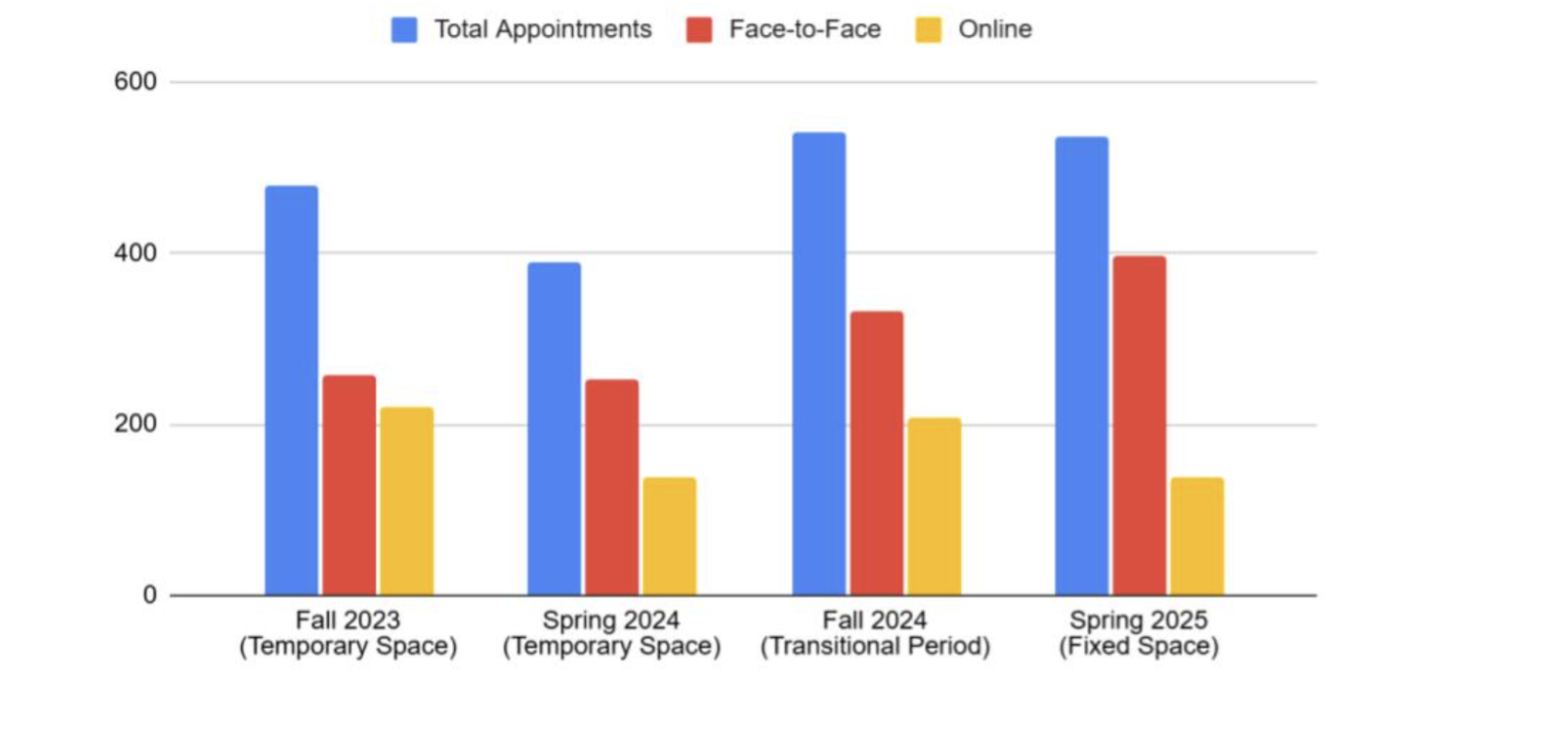
In Figure 1, a clear increase in the center’s usage during the transition period of relocation is reflected. During the semester of transition (Fall 2024) usage increased dramatically. Having a steep increase in a short period of time, signaled a significant point that fostered engagement with in-person center usage. While online support maintained its approximate usage rate for a fall semester, the shift in usage pointed to a clear systematic change with center operations.
Beginning in August 2024, plans were put into place to relocate Writing Central to a fixed location in the library with a sectioned office. Word spread on campus about the move (though it had not yet been officially approved). Then, that November, Writing Central announced that it was now open on the lower level of the library, next to the accessibility office and the testing center. Students could now classify writing support with other, more established academic support centers, thereby placing the same value on the theoretical considerations of writing support as they would on the centers nearby.
The relocation in fall 2024 was a time of movement and clarity. Writing Central focused its efforts on clearly communicating the move to all on campus. No longer would the center be wedged in between classrooms in a narrow hallway. Now students could get one-on-one coaching in a designated, on campus office. Effective campus communication regarding the relocation added another layer of value to the writing center. The information circulated evidenced to the institution the commitment of Writing Central and situated our services as being equal to that of other academic support resources located within the library. For the rest of the semester (two months), Writing Central continued to send campus-wide email announcements about the transition. We posted flyers at student centers and within academic departments, letting the campus community know that the center would now operate in full service with a designated location, alongside other support service centers.
Figure 1 details the increase in usage that occurred in the fall of 2024; sessions increased by more than 100 from the previous fall semester. Based on trends that remain consistent by season, rather than by semester, usage data is typically tracked by corresponding semester (Fall-Fall; Spring-Spring). One might assume that fall usage patterns in 2024 at the time of the transition, would have decreased. However, the increase in usage shows how the transition demonstrated the center’s value within the institution. Observing the increase in center usage at the fixed location, it can be noted that students’ engagement is fostered by their public memory of the center before its move to the temporary space. Wanting to see that value represented through the return to a fixed space may have contributed to this increase in usage.
Public memory of location is established by what is performed in that location.For many, temporary, unclassified functions affect appropriate public memory. Students may have struggled to remember the value of Writing Central sessions they had before the change in location, demonstrated by a clear discrepancy in AY 23-24 usage, compared to that of AY 24-25. When the appropriate classifications of a writing center are not available in its classified location, attachments to the writing center, which correlate to repeated usage, may not develop. Thus, the consistent increase in usage during the transitional period shows that attachments, which led to positive public memory, were made to the location, proximal to other centers, by its users. Contextualizing the importance of crafting public memory of the writing center work means providing positive associations with location in terms of what it reminds students of and how they connect with memories shaped by other academic experiences.. If these factors do not align, participants will be discouraged from identifying with that location as a memory of academic support.
Of the connections between past and present that interact with public memory, Gary Dickinson et al. note the following:
Yes, public memory bears relationships to the present, but those relationships are highly variable and dependent upon contexts, available rhetorical resources, representational choices, framings by various techné, and so forth. Yes, public memory narrates-arguably constructs-shared identities. But it does even more than that. It constructs identities that are embraced, that attract adherents (as well as dissidents). (22)
The public memory shaped by the use of the different locations of Writing Central was supported by affective associations of learning support conducted in either location. As usage declined in Spring 2024, it was clear that public memory was shaped in a way that developed dissidents against the work done in the temporary location. However, as public memory intertwined with the new location, adherents were able to replace the memories of misclassification, which was shown in increased usage in spring 2025.
The ability to transition to a fixed, designated location gave outsiders the opportunity to make positive associations with the work done at Writing Central. If students did not know where Writing Central was now located, they could easily remember that it was located in the proximity of other support services. This feature eased communication about the move because students had already developed behavioral associations with the new location. In fact, much of Writing Central’s usage now overlapped with that of the testing and accommodation center, due to proximity, which led to the student ease of connecting to the existing academic support on campus.
Students were able to replace nonassociative memories with associative ones. Had they placed any value on the support offered by the library, the accessibility office, or the testing center, they would have then added that associative value onto the writing center. Having the center far removed from that associated location may have confused the value placed on the work done in context to that of other designated support centers. Considering how location communicates value in referencing Lefebvre’s work, Chai notes that “Every language is located in space. Every discourse says something about space (places or sets of places); and every discourse is emitted from a space” (qtd. In 40). If discourses of writing center work are not appropriated by the location, communicative practices would lose their effectiveness. However, the increase in usage that occurred during the move to the fixed location highlighted the need for writing center discourses to be appropriated by its location on campus.
Fixing Location to Demonstrate Writing Center Value
In the first week of November 2025, Writing Central officially moved into our new office on the lower level of the on-campus library. Students could flow in and out without being restricted by key card verification and had access to printing services and computer use if needed. There were no classrooms on the lower level, so there weren’t distractions from large groups of students passing by. Since the move to this location, Writing Central has been able to offer identifiable support in context with other academic support centers who have been fixed within the library for years.
Many events to promote campus services take place within the library, which allows Writing Central easy access to these promotional events to offer our own promotion. Prospective students visiting campus often attend orientation events within the library. This creates a convenient opportunity to connect with students in close proximity to Writing Central whenever we welcome them to campus. Oftentimes, due to its office location within the nexus of university academic support, many students recognize Writing Central as one of their first points of contact for on-campus support in their academic work.
This proximal power would not exist—or exist only within the margins—if our writing center were still placed in a temporary, unclassified location. Proximal power confers value, shapes perception, and is tacit recognition of institutional value placed on writing centers (despite any perceptions of its precarity). Proximal power also allows for a tangible display of support on campus, reflected in the university’s shared value in the center’s existence.
Figure 2. Month-by-month usage during transitionary period
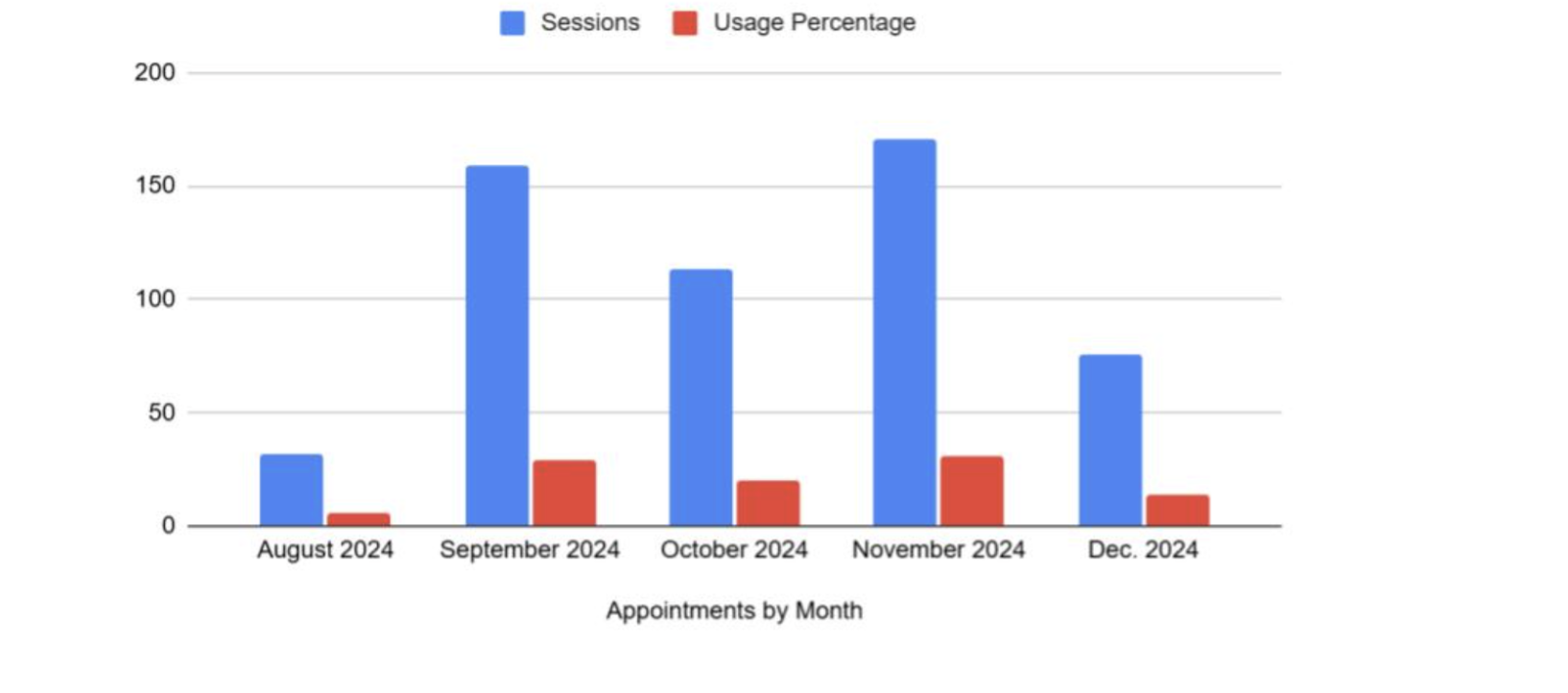
Figure 2 provides a clear breakdown of each month of the fall semester in which Writing Central’s physical location was moved from the business school to the fixed location in the campus library. During the start of the semester (August 2024), there was a reduced rate of usage compared to that of the previous AYs. In August, the center maintained its hours with the start of the academic, sixteen-week semester, which began during the second week of the month. This reduced availability considerably, compared to September and October months.
October signified the month that featured the most evidence of the effects of this transition. From September to October, there was a considerable reduction in usage based on the number of sessions that took place. During October, Writing Central staff prepared to transition to the permanent location, which meant taking up coaching time to work through the transition, i.e. move furniture, curate the new space within the location, and prepare campus-wide communication. This is reflected in the reduced usage rate from September to October. Events that occurred in November had an exponential effect on usage for the center. Below (see table 2) is a breakdown of the usage patterns in November.
Table 2. Number of sessions and usage percentages

The table above (see table 2) demonstrates percentages of usage throughout the Fall 2024 semester at its highest in November 2024. In examining other factors that could have affected the usage rate and comparatively high number of sessions, the usage reflected by the transition to the new location remains consistent.
At Palm Beach Atlantic University, major academic moments in the fall semester such as midterms (October) and final exams (December) typically result in an increase of usage at the center; students may seek support to prepare for these assessments. However, one would typically see that increase around those specific months. The idea that a sudden and sharp increase in usage during the month of November can strictly be attributed to the instance in providing support in the new location.
While August, October, and December feature major academic events and reduced academic weeks, November 2024 featured no atypical factors outside of a regular, academic month. Outside of a federal holiday, which removed a total of three days from the calendar, there were no changes during this month, outside of the transition of the writing center to the new location.
The number of online sessions across each month of the transitionary period (see table 1) also provides key insight into the correlation between the transition to the new location and increased usage. While the rates of in-person, face-to-face sessions increased during and after the move to the fixed location, rates of online sessions decreased. Factors such as population growth, effective promotion methods, and major academic events do not easily account for the consistent decrease in online sessions and the increase in these in-person sessions, resulting in comparatively higher rates of usage in Spring 2025 than in Spring 2024.
If these factors superseded the effectiveness of the transition to the fixed location, online rates would not decrease. Rather, what these trends demonstrate is a clear increase in inviting discourses that have been made present in the new, fixed location. These considerations argue that writers are supported as much by their environment as they are by what takes place in that environment.
Conclusion
This study suggests that careful consideration must be given to the geographic location of a writing center, and that the location may determine how students value its services. Proximity to power makes the argument that auxiliary support for students is vital to the life of the institution. When the location of the writing center is unsuitable or inappropriately placed, students are less likely to seek its services. Creating a public memory that is positive among outsiders requires more than just service and writing competence. The experience of a service requires clear and consistent appropriations based on Burke’s patterns of identification.
Writing center administrators must consider what this may mean for the future of writing centers, particularly as their funding and institutional support are often in flux. Boquet considers the consequences of this precarity:
While acknowledging the appeal of programmed instruction in notoriously under-staffed, under-funded labs, these critics nevertheless feel committed to what they deem the fundamental principle of the writing lab: one-to-one contact with "a human being who cares" (qtd. in Veit 2). This philosophy, an extension of the Rogerian nondirective/mirroring model of writing lab operations, led these labs to define themselves in opposition to their auto-tutorial counterparts, to characterize the lab spaces as non- threatening (however specious) and to fill them with creature comforts- couches, plants, coffee pots, posters. (473)
For many writing centers, being understaffed and underfunded means persuading institutions to consider factors that correlate an environment to positive usage percentages. When institutions consider what to do with limited campus space and resources, making an argument for location involves identifying how writing coaches and their writers are affected by their environment.
Writing Central is tremendously grateful for the new location we’re in to offer writers a valued resources of support. The change provided a sense of credibility to our services through spatial rhetoric. As the figure above (see Figure 2) demonstrates, usage continued to increase for the center in Spring 2025 compared to the prior spring semester, showing a positive pattern for usage rates at the library location.
Comparing both monthly and semesterly trends furthers the point that today, our writing center is where it needs to be. Annual assessments will encourage us to consider how location supports our effectiveness. However, the clear picture that has been demonstrated through usage provides context for the value of the work done at the writing center.
Moving forward, writing centers can be encouraged to advocate for their value exemplified in their physical locations on campus. Hatfield et al. further, “According to architectural theorists, space and design decisions should result in a space where people enjoy spending time and where they are happy, productive, creative, and social. Those are certainly worthy goals for a writing center” (171). While this essay does not directly consider the design of writing center spaces, the placement of the writing center is an equally visual rhetorical choice. Writing centers are often tasked with justifying their value to the administrative powers that delegate institutional resources. Similar to Cirillo-McCarthy et al.’s conversation about rhetorical reporting strategies, this essay provides a quantitative analysis to justify qualitative decisions. Through usage data, writing center practitioners can use quantitative data to create narratives around its value, ensuring that its quality is truly represented. As of Fall 2025, Writing Central has become a flowing nexus of academic support on campus in its designated library location. Students continue to navigate to Writing Central when in the library in search of other support services. Identifying value inherent in location takes a strong rhetorical stance when demonstrating our value to administrators. We hope Writing Central’s data tracking efforts will further challenge affronts to writing center value if and when future conversations of potential relocation arise. Despite the inevitable decisions made regarding writing center location, which often lay outside of the center’s control, I hope this discussion encourages conversations about representation and the deeper meanings of place that affect the writing center’s function and value as it seeks to support and be supported by its institution.
Works Cited
Boquet, Elizabeth H. “‘Our Little Secret’: A History of Writing Centers, Pre- To Post-Open Admissions.” College Composition and Communication, vol. 50, no. 3, 1999, pp. 463–482, https://doi.org/10.58680/ccc19991340.
Cirillo-McCarthy et al. “Writing Center Reporting Strategies That Subvert Institutional Absurdities.” The Peer Review, vol.7, no. 1, 2023, https://thepeerreview-iwca.org/issues/issue-7-1-featured-issue-reinvestigate-the-common-places-in-writing-centers/writing-center-reporting-strategies-that-subvert-institutional-absurdities.
Camarillo, Eric C. “The Writing Center as a Border Processing Station.” Systems Shift: Creating and Navigating Change in Rhetoric and Composition Administration, edited by Carter, Genesa M., and Aurora Matzke, UP of Colorado, 2024, pp. 235–248.
Carino, Peter. “Power and Authority in Peer Tutoring.” The Center will Hold: Critical Perspectives on Writing Center Scholarship, edited by Pemberton, Michael A., and Joyce Kinkead, Utah State UP, 2003, pp. 96–113.
Chao, Roger. “Analyzing Physical Spaces As a Means of Understanding Rhetoric.” Prompt: A Journal of Academic Writing Assignments, vol.4, no. 1, 2020, pp. 18-28, https://doi.org/10.31719/pjaw.v4i1.54.
Dickinson, Greg, Carole Blair, and Ott, Brian L, editors. Places of Public Memory: The Rhetoric of Museums and Memorials (Rhetoric, Culture, and Social Critique). U of Alabama Press, 2010.
Giaimo, Genie N. “Trading Spaces: Space as Metaphor for Contingency in Writing Centers.” The Writing Center Journal, vol. 41, no. 1, 2023, pp. 35–41, https://doi.org/10.7771/2832-9414.1949.
Hang-Wiles, L. “Counterstory: Ignored Labor with a Writing Center.” Storying Writing Center Labor for Anti-Capitalist Futures, edited by Giaimo, Genie, and Daniel Lawson. The WAC Clearinghouse; University Press of Colorado, 2024, pp. 99–102.
Hatsfield, L. et al. “An Ideal Writing Center: Re-Imagining Space and Design.” The Center will Hold: Critical Perspectives on Writing Center Scholarship, edited by Pemberton, Michael A., and Joyce Kinkead, Utah State UP, 2003, pp. 166–76.
McKinney, Jackie G. Peripheral Visions for Writing Centers. UP of Colorado, 2013.
Mcclellan, Erin D. “Making Sense of the City: Place, Space, and Rhetoric in Portland’s Pioneer Courthouse Square.” Liminalities: A Journal of Performance Studies, vol. 4, no. 1, 2008, pp. 1–32, http://liminalities.net/4-1/pioneer.pdf.
North, Stephen M. “The Idea of a Writing Center.” College English, vol. 46, no. 5, 1984, pp. 433–46, https://doi.org/10.2307/377047.
Williams, Bronwyn T. “Writing Centers, Enclaves, and Creating Spaces of Change Within Universities.” Writing Center Journal, vol. 40, no. 3, 2022, pp. 6-20, https://www.jstor.org/stable/e27220877.
Wittman, Kara et al. “The Writing Center is Not a Place.” The Post-Pandemic Writing Center: A WLN Digital Edited Collection, edited by Sarah Rice, Katunich, and Lape, PressBooks, 2024.