Praxis: A Writing Center Journal • Vol. 23, No. 3 (2026)

Image: Michael Bon / Canva.
Grad Expectations: Student Perceptions of Graduate Writing Centers and the Writer-Consultant Relationship among High-Frequency Users
David Hershinow
The Graduate Center, CUNY
dhershinow@gc.cuny.edu
With Kristie Schlauraff, Daniel Hengel,
Deborah Philip, Anna Carroll, and Charles Colwell
Abstract
All writing centers have students who discover the value of making frequent appointments, but graduate writing centers experience this phenomenon in ways that warrant distinct attention and research. This study analyzes the survey responses of 32 high-frequency, long-term (HFLT) users—defined as students who made 10+ appointments over a 30-month period—in order to understand how they perceive the student-consultant relationship and the role this ongoing relationship plays in their development as academic writers and researchers. Using a grounded approach that privileges the perspectives of respondents, the study finds that HFLT users see writing center consultations as a unique source of granular writing instruction and overall professionalization support. In describing their relationships with consultants, they reveal how these interactions benefit from an attention to both practical and emotional needs, as well as how they can parallel other important relationships like those with advisors. Finally, respondents consistently link the consultational focus on the nuts-and-bolts of writing process to their growing confidence as advanced academic writers. These findings support big-picture arguments about the future role of graduate writing centers within the wider landscape of graduate education, positioning them not only as a source of occasional feedback for students, but also as a new source of serial, long-term, transformative instruction and support. They also provide insights that can inform improvements in the delivery of writing center services, especially with respect to graduate students who engage with their writing centers as HFLT users.
Keywords: Graduate writing centers, professionalization, writing instruction, writerly identity, graduate education, student-consultant relationships, writing support, confidence
Introduction
All writing centers have students who discover the value of making frequent appointments, but graduate writing centers (GWCs) experience this phenomenon in ways that warrant distinct attention and research. Graduate students who are high-frequency, long-term (HFLT) users—who we define as students who have made 10+ appointments between August 2022 and January 2025—can provide us with valuable, sometimes unexpected insights. Their perspectives can inform our thinking about big-picture questions concerning the role that graduate writing support can and should play within graduate institutions and help us understand how GWCs fit into the larger networks of support that students rely on, such as peers, faculty advising, writing groups, and works-in-progress presentations. Furthermore, we believe our HFLT users can provide a new angle into more granular questions about tutor training, the processes of graduate student professionalization, and the occluded genres that mark much of graduate student writing.
The past twenty-five years have seen a steady drumbeat of advocacy-oriented arguments from scholars like Bradley Hughes, Shannon Brooks McClellan, Sarah Summers, and Stacy Wittstock et al. that seek to justify the need for more GWCs and course-based writing instruction. [1] Such pieces variously point to evidence that many—if not most—graduate students struggle to hit their completion milestones, juggle complex tasks, plan and write papers, overcome social and emotional obstacles, and forge identities as scholars and professionals, suggesting that there is a gap in the current approach to graduate education into which many students are falling, to their considerable detriment. But while these arguments are persuasive in their broad strokes, more follow-up research is needed to understand precisely what role GWCs and writing courses end up playing for graduate students when these forms of support are available to them. Do students understand these forms of support as filling a gap in their graduate education? How do they understand writing centers to be serving them? How do they understand GWC consultations within their larger ecology of support? We can begin to answer these and other questions by listening to, and learning from, the graduate students who use these services the most often, the students who presumably understand themselves to be getting something distinct and valuable from these additional resources.
Over the same quarter century, published work directed toward fellow GWC administration and staff has tended to center around operational concerns. How best can we train graduate writing consultants to approach sessions in which they and their student clients inhabit different domains of academic expertise? [2] What kind of training best prepares graduate tutors in particular to support peers with varied disciplinary knowledge who must write across many genres? [3] What does the graduate student tutor experience look and feel like? [4] These are all important questions for us to be asking and answering, especially at a time when more GWCs are opening every year. However, contributions to these conversations tend to be grounded in the experiences of consultants and writing center administrators. At present, there is a notable absence of work that builds toward its conclusions on the evidence of student perspectives. Our IRB-approved, survey-based research was designed to fill this gap. The short-answer questions in particular were drafted to provide graduate student writers with a platform to articulate their relationship to and use of our GWC, their understanding of the role writing plays in their experience as emergent scholars, and how they see themselves in relation to their writing practices. [5]
Ultimately, our study bridges these two vital conversations: the first regarding the institutional value of these spaces and their involvement in the educational trajectory of graduate students and the second on the cultivation of best practices in a field where widespread conversation across institutions has remained challenging and often focuses on consultants’ perspectives (Summers 55). Drawing on survey data collected in spring 2025, we seek to understand how graduate students conceive of the role that our writing center plays in their larger network of writing support and how our practices shape the relationship both between writers and consultants and writers and their work. In doing so, we hope to infuse graduate student perspectives into our collective understanding of the role writing centers can and should inhabit within graduate education.
While our discussion remains focused on graduate writing centers specifically, we believe our findings can usefully inform hybrid centers that serve both graduates and undergraduates. Indeed, the same can be said for undergrad-only centers that help students pursue research projects like the senior thesis. All writing centers need to think about how they support the distinct high-frequency needs of academically ambitious students who undertake original research projects—and who must produce the longform academic writing that results from them. We offer this study as a contribution to this larger conversation.
Background
The proliferation of GWCs has been fueled by the growing acknowledgement that graduate-level writing support is distinct from other forms of writing support, and the awareness that graduate students are not merely students, but emergent professionals in their respective fields. Consequently, their relationship to writing is much different than that of undergraduate students. In fact, they often have what Bethany Ober Mannon describes as “sophisticated understandings of their own writing processes” that enable them to assemble resources and seek support in more targeted ways (59). For MA and PhD candidates, writing is more than a skillset; it is a vital tool for collective knowledge building and an integral means of forging identities. [6] As Cecile M. Badenhorst so aptly points out, “writing is the key vehicle for participating in disciplinary conversations, for accessing research funds and for progressing in an academic career. The consequences of not being successful are high” (107). The anxiety that this reality provokes in graduate-student writers is exacerbated by the frustrating fact that writing practices often remain largely invisible and seeking much-needed feedback from faculty advisors, GWC consultants, and even peers is often complicated by feelings of shame and self-doubt, as well as uneven power dynamics within those relationships. [7] The pervasive and often-unchallenged sense that graduate students should already know how to produce advanced scholarship adds an unwarranted and unnecessary degree of pressure that can ultimately worsen retention and completion rates.
The understanding of graduate students as entering their programs with a degree of experience and even expertise that undergraduates lack has, unfortunately, been one of the factors that delayed the creation of GWCs; as many scholars have pointed out, the lack of graduate writing instruction largely stems from a fundamental misunderstanding on the part of institutions, advisors, and faculty that graduate students enter their programs knowing how to write, a false premise that can immediately make students feel insecure about their writing and that fuels the idea that a student in good standing wouldn’t need ‘extra’ writing support (Wittstock et al. 31; Mannon 59). This myth has also been at least partly responsible for the perception of GWCs as remedial spaces intended to help only graduate students who are somehow ‘behind’ or ‘weaker writers’ due to some sort of lack, including but not limited to, English language fluency, academic preparedness, a priori knowledge of genre conventions, and institutional, linguistic, and cultural capital.
If our experience at The Graduate Center, CUNY is any guide, then the reality of graduate writing practices is quite different indeed. A public R1 university, The Graduate Center focuses solely on graduate education, offering 31 doctoral programs and 18 masters programs. Because our institution serves New York City and its surrounding region, our student population is particularly diverse on many different metrics, including race, socio-economic background, and educational history. The students who come to our writing center reflect that diversity, ranging from MA students returning to the classroom decades after earning their previous degree to PhD candidates chasing the highest professional ambitions that academia has to offer. All of these students seem to find value in coming to The Writing Center, and the graduate-level needs they seek to fulfill tend to stymie the remedial/advanced binary so often imposed on academic writing support. Notably, the creation of our GWC—established in 2019—was the result of student-led advocacy by the Doctoral and Graduate Students’ Council, the sole policy-making body representing students at The Graduate Center. In this respect, its origin story resembles that of UCLA’s GWC. In both cases, highly involved graduate students at public R1 universities advocated for their own needs, needs that are often unique to graduate-level education and all too often remain unaddressed unless graduate students are active participants in both institutional conversations and writing studies scholarship.
Now in its seventh year of existence, our GWC is small but mighty. It is led by a full-time Director and is staffed by two part-time Senior Writing Consultants (PhD in-hand) along with three graduate fellows, all of whom work roughly fifteen hours per week. In AY ‘24-‘25, our center completed 1,178 individual consultations and ran 25 workshops, 5 week-long dissertation and thesis writing clinics, and 9 weekly accountability groups. Taken together, these services produced 2,315 student engagements by supporting 546 unique users, or 17.6% of The Graduate Center’s student population.
Methods
Our study seeks to understand the motivations and user experience of graduate writers who schedule frequent one-on-one consultations at The Writing Center over a meaningful length of time. As stated earlier, we define long-term users as clients who made 10+ appointments with our consultants between August 25, 2022 and January 30, 2025. This metric served as our primary inclusion criteria for participant recruitment. It was designed to capture a wide range of student users, from those who made less frequent appointments over multiple years to those who made 10 or more appointments in a single semester. [8] We identified HFLT writers by pulling a usage report of all client appointments from our history on WCONLINE, a scheduling management system that we have used consistently from August 25, 2022. Consultants sometimes scheduled appointments for writers under their own names when students experienced issues logging into the system. In those instances, we gathered written information recorded in appointment history to identify the writers for each session and cleaned the data to ensure a more accurate appointment count. Several completed appointments remained unlocatable due to limitations of data storage on WCONLINE. Ultimately, out of 548 total clients, we were able to isolate a subset of 75 writers with 10+ appointments. While this means that just 12% of clients are HFLT users, that same subset notably accounted for 39% of all appointments within the above date range. Of the 75 potential candidates we recruited, 32 completed our survey. Notably, only 2 respondents identified themselves as coming from the sciences, with the remaining 30 respondents being a roughly even split between the humanities and social sciences.
We designed our survey with three key research questions in mind:
How do HFLT users understand the function of The Writing Center and its relation to their larger network of writing support (e.g. advisors, faculty, peers, and other centers)?
How do HFLT users understand the role that consultants play in their writing process and the relationships they develop through frequent interactions with those consultants?
Do HFLT users experience a change in their self-perception as academic writers, and, if so, how do they make sense of that change?
These questions shaped the structure and implementation of an IRB-approved, anonymous, online survey that we created using Qualtrics and distributed through email in spring 2025. The survey consisted of three parts and took approximately 30 minutes to complete. We requested that participants complete it within two weeks and sent a reminder two days prior to the deadline.
The first part of the survey asked participants to answer 12 basic factual questions intended to establish their progress to degree, discipline, language use, frequency of visits to The Writing Center, use of other campus resources relevant to the writing process (e.g. advisors, peer groups, library services, etc.), and specific tasks engaged in during writing center consultations (e.g. brainstorming, preparing and revising job applications, understanding feedback, understanding specific genres, etc.). These questions helped us gain a clearer sense of how The Writing Center fits into the larger network of support that our students use to develop, revise, and complete writing projects, and to understand how our perceptions of the services we provide as consultants do and do not align with the perception of HFLT users.
The second part of the survey asked participants to answer 15 sliding-scale questions, indicating their level of agreement or disagreement with 15 statements about the role of The Writing Center and their relationship with consultants on a 5-point scale (strongly agree, somewhat agree, neither agree nor disagree, somewhat disagree, or strongly disagree). Whereas the basic factual questions allowed us to better identify what kinds of writing tasks HFLT users engaged in during consultations, these sliding-scale questions provided us with a clearer understanding of how their prolonged interaction with consultants has impacted their perception of The Writing Center and the writing process.
Finally, participants were invited to respond to nine short-answer questions intended to deepen our understanding of the role that consultations play in their writing process more broadly, and how they understand their relationship with consultants to be similar to and different from other sources of support (such as their advisors). Knowing that short-answer questions can make some writers feel anxious, we encouraged participants to use informal language and skip questions where they did not feel that they had much to say. Questions in this section focused specifically on interpersonal relationships between students and consultants, motivation and self-perception of writing ability, learning transfer, and overall perception of The Writing Center.
In focusing specifically on HFLT users, and in asking them to contextualize their use of The Writing Center alongside other sources of support, our study emphasizes how the learning and personal trajectories of writers are impacted by consultations in ways that are distinct from other interactions. If this is the case, understanding what leads our HFLT users to consistently turn to The Writing Center might not only help GWCs establish best practices but also spark broader changes across other modes of support vital to graduate education. Keeping this in mind, we analyze our data using a grounded approach that privileges the perspectives of our respondents and uses their own experiences and interpretations of The Writing Center as the starting point for envisioning how the role of GWCs might evolve as they become more widespread within graduate education.
Results And Significance
Demographic Insights
Responses to the factual questions in our survey revealed several demographic insights about our 32 participants that provide valuable context for our findings. 63% of respondents reported that they were at or beyond the dissertation stage of their degree, suggesting that students in the thick of writing their dissertations are the most likely to make serial, long-term use of writing center appointments. Nearly half (47%) reported that English is not their first language. Heritage languages listed include Korean (2), Turkish (2), Spanish (2), Hindi (2), Mandarin (2), Western Armenian (1), Japanese (1), Portuguese (1), and Cantonese (1).
Finally, 69% of respondents had never visited a writing center before entering graduate school. Consequently, their perceptions of GWCs prior to coming to their first appointment were often based on myths about UWCs rather than first-hand experience receiving feedback from a consultant. [9] As one respondent explained, “I think my idea of what a writing center did was very limited, and more like what I envisioned an undergraduate center to be. What I had in mind was something like peer tutoring, or fairly basic feedback regarding style, punctuation, etc.” This statement echoes a broader misunderstanding of GWCs as places where consultants proofread and copy-edit or where students go only to seek remedial support. Yet, our results suggest that GWCs can effectively combat these stereotypes by clearly communicating the kinds of support they offer, particularly at key moments within graduate life like new-student orientation. When asked “How did you first hear about The Writing Center?” respondents overwhelmingly (62%) pointed to our own outreach efforts: 22% heard about us at new-student orientation, 34% saw an email, and 6% saw a flyer. Comparatively, only 13% heard about us from an advisor or instructor.
GWCs As Sites Of Granular-Level Writing Instruction and Professionalization
It may come as little surprise that a critical function of our writing center for HFLT users is an emphasis on the particularities of writing as practice. In fact, despite our respondents’ inclination to seek multiple forms of support, there remains a distinct and near-universal acknowledgement of a lack of granular-level instruction outside of The Writing Center. Responding to the short answer question, “Do you get something out of your work with The Writing Center that you don’t get from other sources of support? If so, what is it?” students not only emphasized the value of the one-on-one instruction they received but also revealed that this intense need was not being met elsewhere. For instance, one respondent said, “Yes, Because the focus is on the act of writing, this is unique and very important to my work as a graduate student, which I feel is not addressed by basically any other kind of support I receive.” Another said, “There is no other space at the GC to learn how to write. My advisor doesn’t have the capacity to teach to write, neither do other faculty.” Others noted that The Writing Center offered “very specific advice on scholarly production,” “discussions of real concerns about my writing,” and “help with all of the other writing work [beyond the dissertation] that graduate students should be doing.” Ultimately, 19 out of 22 respondents mentioned some form of support vital to developing confidence and writerly identity, from these kinds of granular-level instruction (13) to dedicated one-on-one attention (5) and detailed feedback (4). This same trend was evident in responses to the short-answer question, “What is the most significant thing you’ve learned through your writing center consultations?” where 18 out of 21 HFLT users mentioned transferable skills that they learned relating to various aspects of the writing process, from “transition sentences” and “approaches to organizing my thinking and writing” to “the importance of revision” and “meta theories about writing.”
Collectively, these responses suggest that our HFLT users understand The Writing Center as a place where they can learn both the guiding principles that inform academic writing and the concrete, practical strategies involved in revising their way toward strong final products—two emphases they do not associate with instruction in their home programs. This issue is not isolated to our institution. As Wittstock et al. explain, “because getting accepted to graduate school in many ways feels like the apex of writing, many graduate students and their advisors feel they should already be experts in writing” (31). Of course, the reality is that students entering graduate school still have a great deal to learn about academic writing. This is true not only with respect to the writing and revision process, which is necessarily more complex when it is being used to develop and communicate large-scale research projects, but also with respect to navigating the many genres of academic writing that students rarely need to work in before entering graduate school.
At The Writing Center, we have found that persistent attention to granular writing instruction often entails explicit discussion of what Jon Swales terms “occluded genres”—forms of writing that are not part of the published record and therefore remain “hidden” and “out of sight” for the uninitiated (46). Graduate writing is marked by occluded—and therefore under-exemplified—genres: CFPs, fellowship and grant proposals, conference abstracts and presentations, prospectuses, the dissertation itself, and job cover letters. The occluded genres that suffuse the graduate writing experience are the very forms of writing students must master in their evolution as professional graduate students, scholars, teachers, and academics. Yet, graduate instruction at-large remains woefully underprepared to help students navigate these all-important and opaque forms. Wittstock et al. note, “occluded genres are problematic, particularly in graduate school, because there is a faulty expectation that apprentices will simply osmose knowledge of them by virtue of entering a discourse community” (32). This may be because, as Wittstock et al. aptly point out, “advisors often have trouble articulating genre typifications, perhaps in part because they were never directly taught those typifications themselves; thus, they have little conception of how to teach students genre-specific conventions and expectations” (32). Here, our center, and GWCs more broadly, acts as a professionalization force-multiplier that leads students to develop a nuanced understanding of a host of untaught genres across the timeline of graduate student life. Consequently, they can more nimbly move between the role of student and professional and cultivate a writerly and scholarly identity.
The ability of GWCs to help graduate students with diverse disciplinary backgrounds professionalize is evident in the responses from our HFLT users. When asked, “Do you feel like your writing center appointments have directly led to better professional outcomes? If yes, how so?” all 21 respondents replied in the affirmative and, importantly, recognized these variegated genre forms as aspects of professionalization. For some students, being asked about professional outcomes led them to think in terms of publication:
Yes, I published four articles and five book/performance reviews with the help of the writing center. I believe I could finish my PhD within 5 years thanks to the writing center’s support.
I was able to successfully work on revisions on a peer reviewed paper and publish it (yeaay!).
But, notably, a much larger number chose to focus on occluded genres in their responses:
I wouldn’t have finished my diss without the WC.
I . . . complete[d] my dissertation and graduate[d]! Overall, I think that my writing has improved.
I have received prestigious grants in my field, and was called in for interviews for fellowships largely because I had the help from the writing center.
Yes, my own teaching pedagogy has improved. Job application materials are vastly improved. A conference abstract was accepted. One journal article is (very, very nearly) ready to go.
All my job application documents were workshopped over multiple sessions with the writing center . . . and I landed a tenure-track position even before I graduated. At this moment, this feels like a big win.
Yes, the cover letters I worked on got me jobs.
Absolutely, my experience editing my job market materials (cover letter, research statements, and diversity statements) with the consultants have been fundamental in that regard.
This wide range of responses indicates that our HFLT users understand The Writing Center as a dynamic and multifaceted source of support for professionalization. It also reveals the breadth of the gap our GWC fills in their understanding of what it takes to be a professional graduate student and, ultimately, a professionalized member of an academic community. Even when consultants have different disciplinary expertise than graduate students, they serve as agile audience proxies, helping HFLT users write for readers they might not know how to speak to or know exist as they navigate unspoken academic expectations. Taken as a whole, our findings reveal the transformative effects that HFLT users understand the writer-consultant relationship to have on their development as academics, a relationship that helps them to productively redefine writing as practice and to demystify a range of academic genres in which they need to excel.
The Role of Writer-Consultant Relationships in Graduate Education
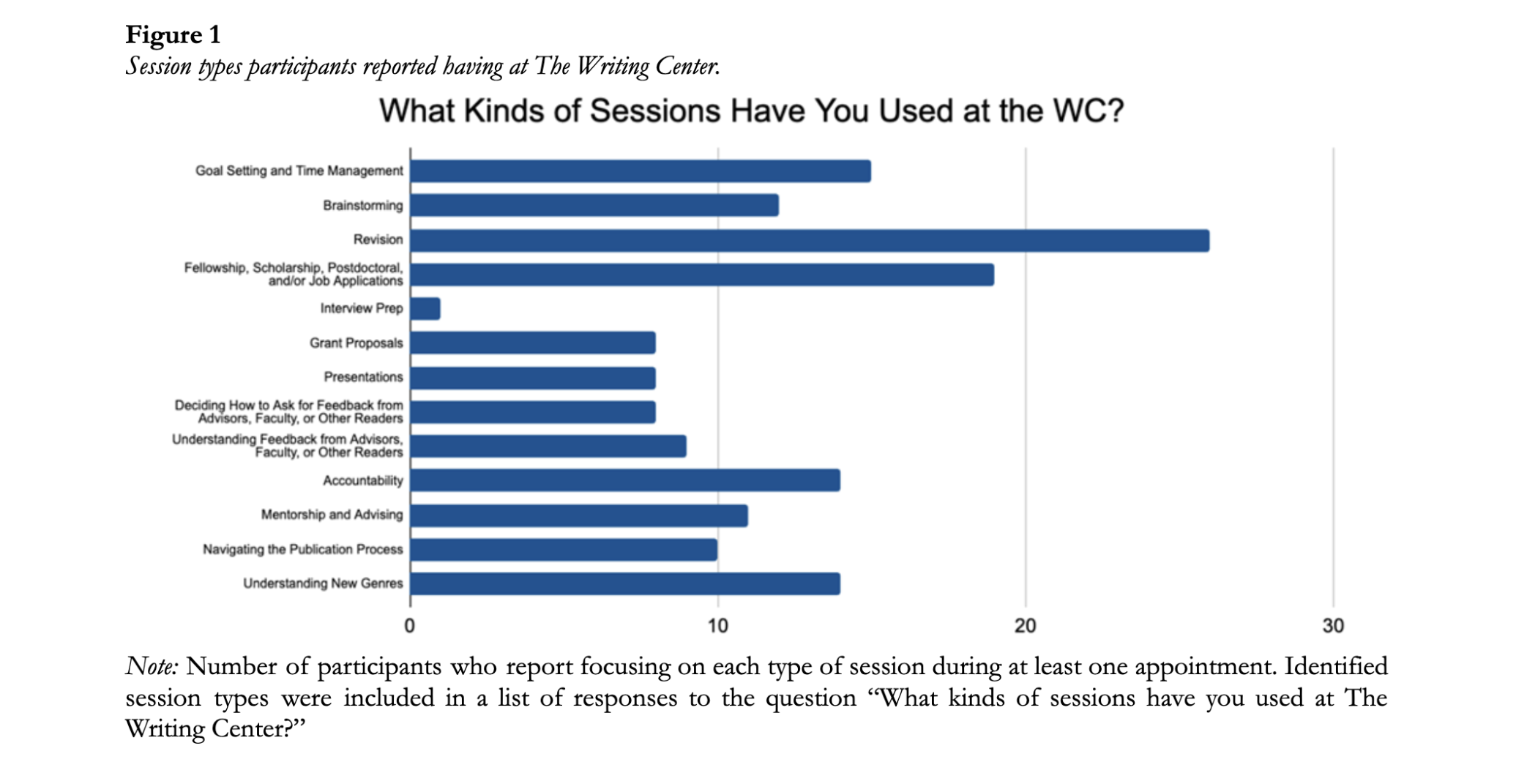
That HFLT users seek granular-level instruction and find valuable professionalization support at The Writing Center is not entirely surprising, but it does raise questions about how the nature of their relationships with consultants make GWCs such effective spaces for this kind of work. [10] Our survey revealed two key characteristics of one-on-one appointments that could account for this: first, the relationship between HFLT users and consultants develops through dynamic conversations about writing practices and the writing process that span multiple projects, genres, and skills. When asked, “What kinds of sessions have you used at the WC? Select all that apply,” respondents reported that they use sessions for goal setting and time management, revision, asking for and understanding feedback, navigating publication, accountability, and a range of other tasks (see Figure 1). 17 of 29 respondents (59%), have used 5 or more different kinds of sessions. Throughout these sessions, 97% of students reported retaining a strong sense of ownership over their work, a finding that reinforces Mannon’s claim that graduate writers have more nuanced understandings of writing that lead them to seek specific kinds of support at specific moments in the writing process.
While HFLT users are largely consistent in terms of using sessions to address a variety of writing skills and genres, they are far more varied in how they understand the role that consultants fill in their writing lives. This is not entirely unexpected; consultants occupy a unique space within graduate education that can be difficult to define because of the many ways GWCs are situated within the broader scheme of institutional offices, programs, and departments. Additionally, the staff of many GWCs, including our own, consists of both graduate-student consultants and consultants holding a PhD with varied experience and expertise in writing and writing pedagogy. A 2020 study from Claire R. McMurray suggests that graduate writers consider differences in disciplinary expertise and writing experience among consultants when booking appointments and choose consultants based on their perceived needs within the context of their projects. McMurray’s survey participants characterized graduate-student consultants as “readers,” “sets of eyes,” and “in-between people” who can offer the perspective of a reader outside their discipline and provide support with specific drafts (13). Meanwhile, they characterized consultants holding a PhD as “guides,” “mentors,” or “coaches” who have both writing and institutional knowledge that allows them to speak more metacognitively about the writing process and valuable experience completing a thesis/dissertation, applying for jobs, and publishing (McMurray 13). Our own survey did not ask respondents to make these distinctions between consultants, a limitation that prevents us from knowing to what degree HFLT users’ perceptions may have shaped the language they used to describe student-consultant relationships. Yet, 87% of our HFLT users “strongly agree” or “somewhat agree” with the statement: “I find that different consultants provide different kinds of support.” These numbers reinforce the idea that our users are aware that each consultant can offer something different as a reader of their work.
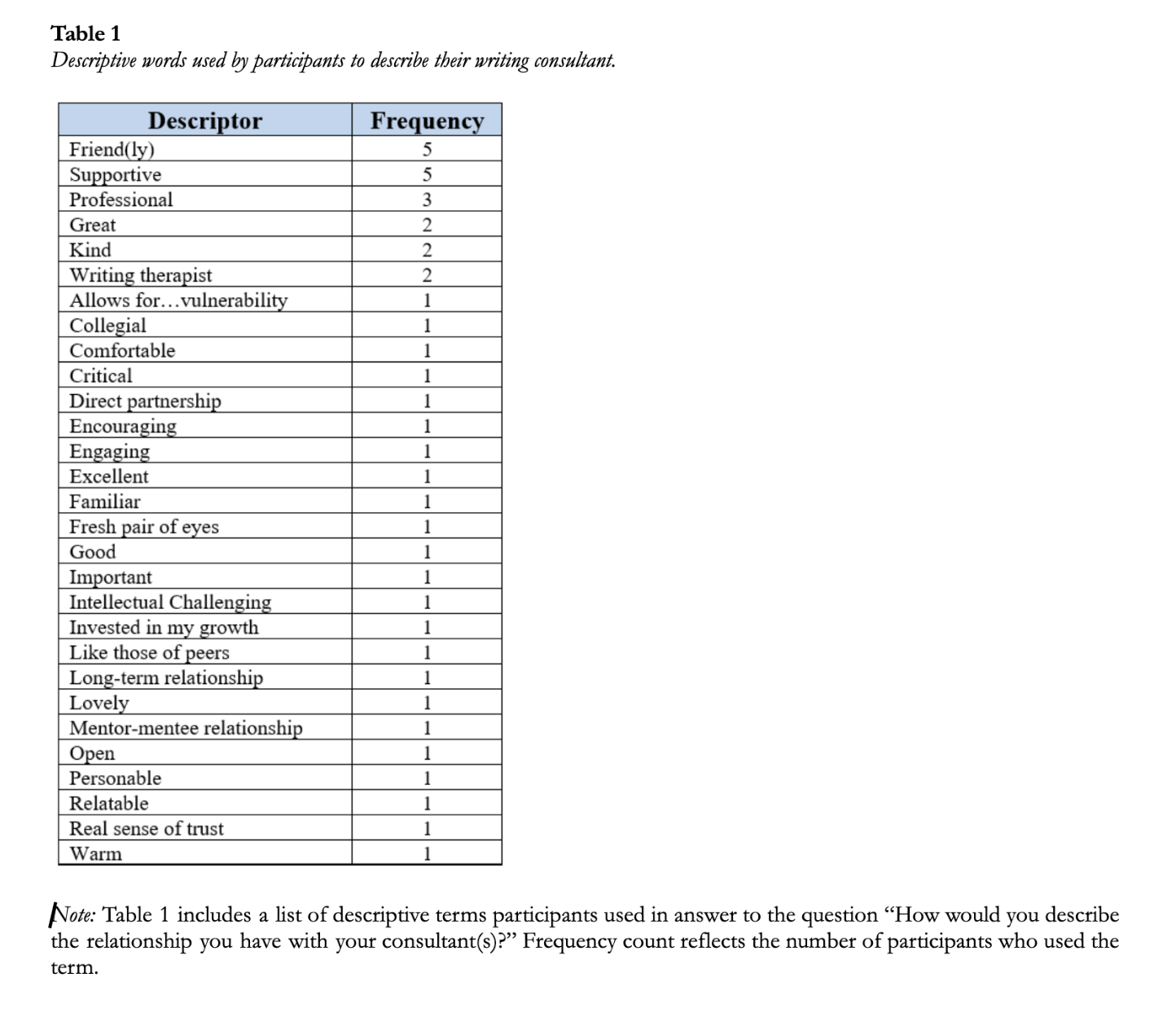
The specific language that HFLT users employed when responding to the short-answer question, “How would you describe the relationship you have with your consultant(s)?” was varied, though there was some repetition of descriptors like “friendly,” “supportive,” and “professional” (see Figure 2).
Interestingly, HFLT users did not use words like “teacher,” “tutor,” or “instructor” in their responses to this question even though they emphasized receiving granular-level instruction throughout the survey. What emerges from their characterizations is a relationship that is sometimes like a friendship (where writers feel supported and perceive consultants as kind, comfortable, familiar, open, etc.), sometimes like a professional relationship between peers (where interactions are collegial and the power balance is equitable), and sometimes akin to a professional relationship with more senior scholars (where consultants assume the role of mentor or “writing therapist,” offer encouragement, and demonstrate an appreciable investment in the writer’s growth).
Respondents often provided descriptors spanning multiple categories, suggesting that the position of the consultant is fluid, a quality that may contribute to the versatility of The Writing Center as a generative site of both granular-level instruction and professional development. However, in some instances there was a tension between “friendly” and “professional.” For instance, one respondent said, “It was friendly but also effectively professional” (emphasis added), a phrase that gestures towards the idea of friendliness as potentially coming at the expense of professionalism. Another respondent commented more directly on this distinction, saying, “So depends—one was super professional/focused on work…The next person was more personable/friendly/commented more personally on my stuff and although that was nice I found that type of feedback less helpful in terms of actually getting work done.” In this instance, the writer implies that privileging professionalism or friendliness gives rise to very different kinds of sessions. A third respondent similarly explained, “Some consultants are very encouraging and kind, but I find that I get the most from those more critical.” While a small percentage of our HFLT users pointed towards this division, 3 of 23 respondents (13%), it is important to consider the delicate balance that GWC staff often need to strike within student-consultant relationships. When asked “What motivates you to keep making appointments at The Writing Center?” 7 of 24 HFLT users (29%) mentioned their close relationship with consultants, as well as the kindness and support they received. This is significant, because one of the biggest sources of anxiety for graduate writers, even more so than other pressing issues like finances and childcare, is receiving feedback on their writing (Badenhorst 106). When we think across the responses to these two questions, it seems that as a best practice consultants should foster relationships that lie somewhere between friendly and professional to most effectively support graduate-student writers. This conclusion is in keeping with research on best practices for cultivating productive student-advisor relationships in graduate education such as Marylee Spillett and Kathleen A. Moisiewicz’s article suggesting advisors move between “support and challenge” roles. While their own descriptors—cheerleader, coach, counselor, and critic—are distinct from those used most frequently by own respondents, their underlying sense that supporting graduate students requires “a toolbox of flexible strategies” aligns with scholarship on GWCs (Spillett and Moisiewicz 255).
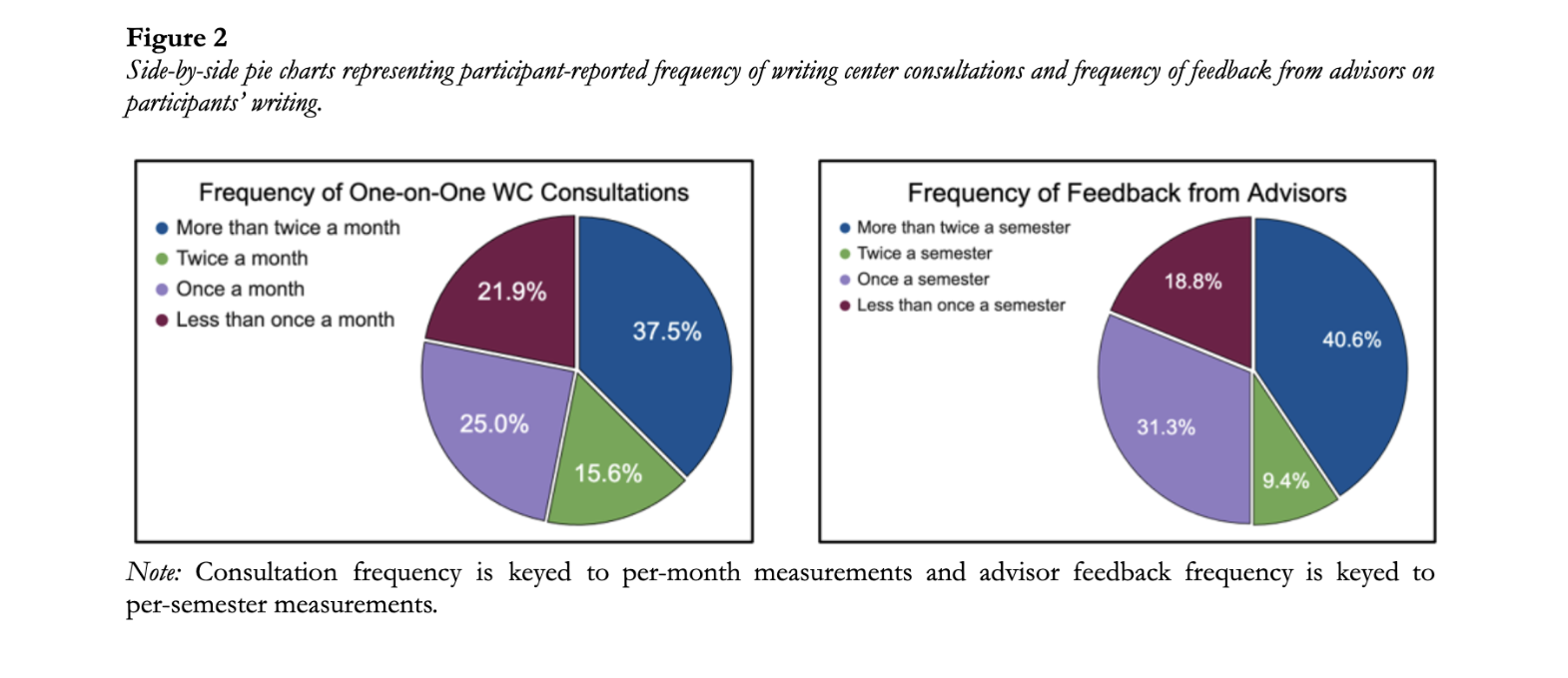
Given that 88% of our HFLT users are in PhD programs, it is instructive to consider these intersections between their relationships with consultants and their relationships with faculty advisors, particularly since the latter also unfold over time through multiple one-on-one interactions involving discussions of student writing and professionalization. In designing our survey, we did not ask many questions related to the student-advisor relationship because we worried that HFLT users may be reluctant to speak about those relationships and concerned that their responses might compromise their anonymity. Yet, we did ask HFLT users two multiple choice questions that yielded surprising, and relevant, results: “How frequently do you come to The Writing Center?” and “How frequently do you receive feedback from your advisor?” Our assumption was that writers who made appointments “Twice a month” or “More than twice a month” (those who met with us eight or more times per semester), would indicate that they received feedback “Once a semester” or “Less than once a semester” from their advisors. In other words, we expected to find that our highest frequency users were likely addressing a deficit in advisor support. Instead, we found a strong correlation between HFLT users who made the most appointments at The Writing Center and those who received feedback from advisors “Twice a semester” or “More than twice a semester.” 7 of the 12 respondents (58%) who met two or more times a month with a writing consultant, also received feedback from advisors more than twice a semester. While this does not tell us about the nature or quality of their student-advisor relationships compared to their student-consultant relationship, it does offer a compelling reason for thinking across them, work that existing research on graduate education and writing studies has not yet undertaken.
Existing scholarship on student-advisor relationships offers some useful insight into the role that advisors play within their advisees’ academic and writing lives. Schlosser et al. define the doctoral advisor as “the faculty member who has the greatest responsibility for helping guide the advisee through the graduate program,” a claim echoed in many studies that suggests advisor relationships could be an important consideration in regards to conversations regarding the gap between preparation and expected performance (179). [11] Faculty advisors are central to supporting, professionalizing, and socializing advisees, which, of course, can impact graduate program completion and retention rates. [12] A large part of professionalization in any discipline involves helping graduate students identify opportunities to present and publish their work, bringing them into disciplinary communities and, in doing so, improving their confidence–tasks that fundamentally depend on their ability to develop, draft, and revise written work (Barnes and Austin 298).
Research focused on how doctoral students perceive their advisors and, relatedly, their advising relationships, captures a wide range of descriptions; over the past 40 years, advisors have been variously framed as guides, evaluators, directors, reliable information sources, advocates, role models, departmental and occupational socializers, encouragers, cheerleaders, coaches, counselors, teachers, and critics. [13] Much like our own study, this research suggests that advisors, like consultants, fill numerous roles for their graduate students that may be in tension with one another. More recent work centered on the perspectives of advisors offers a slightly different set of descriptors. In their 2009 study, Barnes and Austin conducted one-on-one, open-ended, in-depth qualitative interviews with 25 exemplary faculty advisors from the natural sciences, the social sciences, the humanities, and education at a public, research-extensive, land-grant university, asking them a series of questions regarding their understanding of their role as graduate student advisors. The study’s definition of an “exemplary advisor” was “a faculty member who has been one of the top producers of Ph.D. students in his or her department over a five-year period” (302-303). This criterion aligns with Barnes and Austin’s interest in socialization, defined in the context of graduate education by John C. Weidman, Darla J. Twale, Elizabeth Leahy Stein as “the processes through which individuals gain the knowledge, skills, and values necessary for successful entry into a professional career requiring an advanced level of specialized knowledge and skills” (qtd. in Barnes and Austin 301). Ultimately, socialization facilitates the individual and collective identity formation vital to a successful academic career.
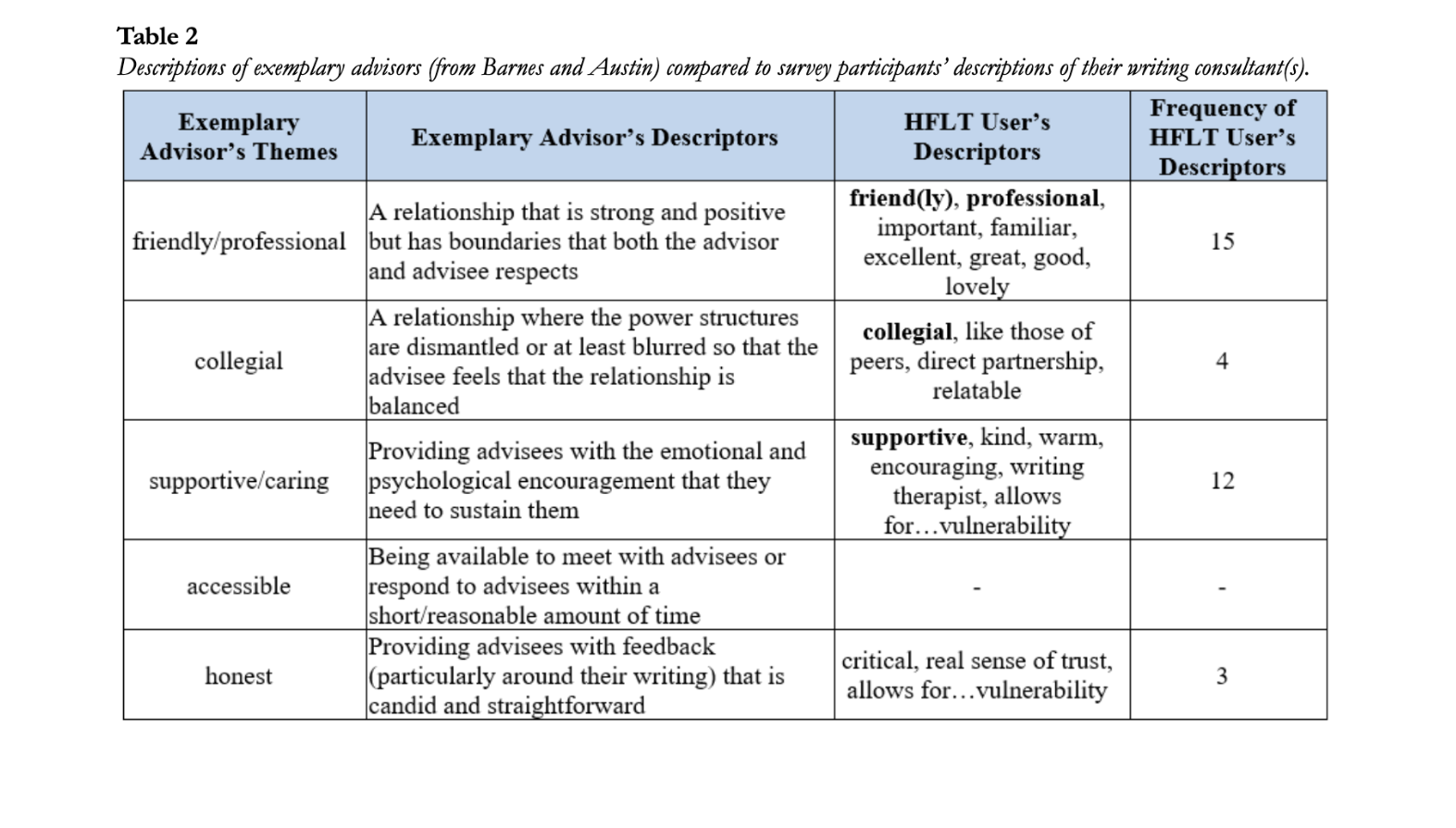
In Barnes, and Austin’s study, participants used five prominent descriptors to classify the characteristics or behaviors of advantageous student-advisor relationships:
friendly/professional, collegial, supportive/caring, accessible, and honest (305).
The definitions they offer for each category are useful in terms of revealing the varied forms of support that graduate students require. For instance, they define a friendly/professional relationship as “strong and positive but has boundaries that both the advisor and advisee respects,” a collegial relationship as one “where the power structures are dismantled…so that the advisee feels that the relationship is balanced,” a supportive/caring relationship as “providing advisees with the emotional and psychological encouragement that they need to sustain them,” and an honest relationship as “providing advisees with feedback [particularly around their writing] that is candid and straightforward” (305 emphasis added). Collectively, these characteristics and behaviors point towards the conclusion that what makes this set of faculty advisors exemplary is an attention to graduate students’ emotional and practical needs (i.e. professional development). This conceptualization of the ideal advisor relationship is supported by Barnes, Elizabeth A. Williams, and Shuli Arieh Archer’s study on how graduate students perceive positive and negative advisor attributes. Those who claimed to have satisfactory relationships highlighted that their advisors were “supportive, friendly, collegial, and respectful” (Barnes, Williams, and Archer 37). Being an exemplary advisor, then, depends on a faculty member’s ability to forge multi-faceted relationships similar to those our consultants seem to have forged with our HFLT users. The language that our graduate writers used when asked “How would you describe the relationship you have with your consultant(s)?” closely parallels the language that exemplary advisors established when asked “What is the nature of the relationships that you have with your advisees?” (Barnes and Austin 302). While our HFLT users did not directly reference accessibility, this is likely because GWCs regularly offer appointments and ensure consultants are available to meet throughout the semester. Our own GWC allows students to make up to one appointment per week, a level of accessibility that would be challenging for advisors to achieve given their other research, teaching, and service obligations. These correlations are significant given the widespread understanding of graduate advisors as having the greatest responsibility for students completing their programs and having successful careers. They suggest that GWC consultants might be well-positioned to not only offer students additional support but also to contribute to ongoing discussions surrounding best practices, mentorship, and student well-being.
The Product of Revision: HFLT Users and Their Changing Self-Perception as Writers
One way in which the writer-consultant relationship arguably differs from the advisor-advisee relationship is in the sustained focus that gets placed on teaching genre awareness and the nuts-and-bolts process of writing and revision. It is therefore particularly notable that HFLT users link this very focus both to their changing self-perception as writers and to a fundamental shift in how they understand good academic writing to be produced. When asked, “How has your sense of yourself as a writer changed since using The Writing Center?”, 11 of 21 respondents (52%) reported that they have become more confident as academic writers, with several others offering differently-worded answers that invoke related themes (e.g. “an increased sense of agency” and finding more “compassion for myself when I’ve struggled with my writing”). The convergence on a single term is quite striking in itself, but the greater interest lies in unpacking their sense of why they have become more confident, and of the role their engagements with The Writing Center have played in bringing about this change. When respondents try to explain their growth in confidence, many see it as the result of having learned foundational writing and revision skills:
I am still insecure about my writing. But I am more confident of writing as a process—and appreciate all I have learned about strategies for getting ideas on paper, for reviewing what I wrote, for organizing and brainstorming ideas… organizing my time.
I’m still not confident enough but it’s improving. I think I got better at revising.
I see myself as a competent writer now when I used to see myself as an incompetent writer. [...] Learning nuts and bolts writing stuff (topic sentences; Gaipa strategies; the coherence and cohesion stuff from Joe Williams; frontloading; developing a scholarly apparatus; and probably more) helped me start to write stuff that was being taken seriously by editors. And it helped me write, period. When I became confident because I was writing stuff readers could take seriously (because I learned how to communicate with readers which I never learned before) I started being more social and participating in the life of the department. It’s hard to even remember the insecurity that I used to have.
All of these respondents connect their increased confidence as a writer to having gained a better understanding of how to approach writing and revision as a step-by-step process.
Indeed, HFLT users seemed to feel quite strongly about asserting this causal link, so much so that they comment on it widely. Throughout the short-answer section of our survey, respondents consistently tied their growing confidence as academic writers to a consultational focus on basic writerly skills—skills that are often misunderstood and stigmatized as embarrassingly remedial, but which were instead accepted as essential elements of building and communicating knowledge with rigor and precision. For example, we see this same narrative of change emerge when respondents were asked to reflect on their evolving understanding of The Writing Center as a resource:
As an emergent bilingual international scholar, I never felt confident in my writing and I was also shy to meet with a consultant at the writing center. However, since I started attending workshops, accountability groups and individual appointments, I can see the writing center is an incredible resource for academic writers to improve their practice and process.
I have learnt to better manage my anxiety around feedback - this is something unique that I would NEVER associate with the writing center. I was also encouraged to find my voice through my writing. This is not just emotional support - it involves learning concrete skills and reviewing my written work with a keen eye.
Again and again, respondents tied their growing confidence as high-performing academics to writing center support rooted in explicit instruction on the fundamentals of academic writing and research. When asked what motivates them to keep making appointments at The Writing Center, one HFLT user said that they’ve “learned tools that make [them] confident writing, such as–knowing the different types of topic sentences, knowing that topic sentences should be arguments, frontloading, writing cover letters for submissions to journals, and more.” In these and other responses, HFLT users focus on the importance of The Writing Center as a place where they learn both clear guiding principles and concrete writing and revision strategies. More importantly, they implicitly frame the production of strong scholarship—work that is clear, analytically rigorous, well-organized, and all-around smart—as a competency that can be cultivated. Many scholars have discussed the importance of helping novice academics approach the work of writing with a growth mindset. [14] Our findings add to this body of work in two ways. First, responses to our survey suggest that graduate students are often initially stuck in a fixed mindset, assuming that their struggle to produce good writing is the result of innate personal deficiency. Second, our study confirms the positive role that can be played by frequent, process-oriented writing center consultations in getting graduate students to adopt a growth mindset—and to benefit from the earned confidence that comes with it.
Conclusion
HFLT users of our graduate writing center understand their student-consultant relationship to be a very significant source of support as they professionalize and develop as scholars. They view this relationship as both distinct from and complementary to their student-advisor relationship, with a sustained focus on granular writing instruction being one of its most distinguishing features. Crucially, HFLT users consistently posit a causal relationship between this explicit instruction in the practical nut-and-bolts of the writing process and their growing confidence as high-performing academics, suggesting that—at least for high-frequency users—writing centers can play an especially prominent role in a graduate student’s educational and professional trajectory. These findings support big-picture arguments about the future role of GWCs within the wider landscape of graduate education, positioning them not only as a source of occasional feedback for students, but also, and much more importantly, as a new source of serial, long-term, transformative instruction and support. GWCs do not displace the centrality of faculty advisors in a graduate student’s educational experience, but they do afford students with the opportunity to form a complementary and somewhat parallel relationship with one or more people who are highly accessible and extensively trained in consultation best practices.
We hope this study of high-frequency users will be used both to open up avenues for further research into this constituency’s needs, and also to encourage centers that are already no doubt aware of the existence of these users to consider them as a constituency with a particular relationship to the center and its services. This acknowledgement will, we think, help centers address their needs and perhaps also help these users meta-cognitively identify and advocate for their own academic and professional development.
Endnotes
See: Hughes, Bradley, “Looking at Writing Centers Through Scientific Spectacles: The Expertise and Commitments That Characterize Contemporary Writing Centers”; McClellan Brooks, Shannon, “Centerless? Making Sense of Disruptions in the Graduate Writing Center”; Summers, Sarah, “Building Expertise: The Toolkit in UCLA’s Graduate Writing Center”; and Wittstock, Stacy, et al., “Making What We Know Explicit: Perspectives From Graduate Writing Consultants on Supporting Graduate Writers.”
See: Jewell, Megan Swihart, and Joseph Cheatle, editors, Redefining Roles: The Professional, Faculty, and Graduate Consultant's Guide to Writing Centers, Utah State University Press, 2021.
See: Summers, Sarah, “Building Expertise: The Toolkit in UCLA’s Graduate Writing Center.”
See: Wittstock, Stacy, et al., “Making What We Know Explicit: Perspectives From Graduate Writing Consultants on Supporting Graduate Writers.”
For a list of our short-answer questions, see Appendix A.
See: Paré, “What We Know about Writing, and Why it Matters.”
See: Badenhorst, “Emotions, Play and Graduate Student Writing”; Aguinis et al., “Power Bases of Faculty Supervisors and Educational Outcomes for Graduate Students”; Delgado and McGill, “Graduate Students’ Perceptions of Instructor Power in the U.S. Higher Education Classroom.”
Unsurprisingly, some students make frequent appointments every semester and over multiple years. Among the 75 HFLT users identified for recruitment in this study, 4 people had made 100 or more appointments between August 25, 2022 and January 30, 2025, and 12 people had made 50 or more.
Alternatively, for international students who completed their undergraduate education outside the United States, the very concept of writing centers might be new and unfamiliar. These students may not have negative pre-conceptions about the remediality of writing centers from their undergraduate years, but they may still worry that using a writing center amounts to them conceding to a remedial need.
In posing this question, it is necessary to acknowledge the different relational structures that can be at play in a consultation (peer-to-peer, professional-to-student, etc.). Our own center is heterogenous in this regard: we have graduate fellows (peer-to-peer), Senior Writing Consultants (professional-to-student), and one Director (professional-to-student and, when students initiate it, mentor-to-mentee—indeed, sometimes even advisor-to-advisee, albeit informally). When designing our survey instrument, we considered the value of capturing this distinction against the challenges of both building and taking a survey capable of tracking this variable. Ultimately, we decided to leave this variable out. We consider it the most significant limitation of this study that we cannot say for certain which kind of consultational relationship a participant is describing in a given response. Nevertheless, we believe the In posing this question, it is necessary to acknowledge the different relational structures that can be at play in a consultation (peer-to-peer, professional-to-student, etc.). Our own center is heterogenous in this regard: we have graduate fellows (peer-to-peer), Senior Writing Consultants (professional-to-student), and one Director (professional-to-student and, when students initiate it, mentor-to-mentee—indeed, sometimes even advisor-to-advisee, albeit informally). When designing our survey instrument, we considered the value of capturing this distinction against the challenges of both building and taking a survey capable of tracking this variable. Ultimately, we decided to leave this variable out. We consider it the most significant limitation of this study that we cannot say for certain which kind of consultational relationship a participant is describing in a given response. Nevertheless, we believe the quantitative and qualitative findings in this section demonstrate substantial enough patterns to warrant consideration regardless of this limitation.
See: Barnes, Benita J. and Ann E. Austin, “The Role of Doctoral Advisors: A Look at Advising from the Advisor’s Perspective”; Baird, Leonard L., “Helping Graduate Students: A Graduate Advisor’s View”; Lovitts, Barbara E., “Leaving the Ivory Tower: The Causes and Consequences of Departure from Doctoral Study”; and Nettles, Michael T. and Catherine M. Millett, Three Magic Letters: Getting to PhD.
See: Barnes, Benita J., Elizabeth A. Williams, and Shuli Arieh Archer, “Characteristics That Matter Most: Doctoral Students’ Perceptions of Positive and Negative Advisor Attributes”; Ferrer de Valero, Yaritza, “Departmental Factors Affecting Time-to-Degree and Completion Rates of Doctoral Students at One Land-Grant Research Institution”; Givres, Jean E., and Virginia Wemmerus, “Developing Models of Graduate Student Degree Progress”; Pitchforth, Jegar, et al., “Factors Affecting Timely Completion of a PhD: A Complex Systems Approach”; and Seagram, Belinda Crawford, Judy Gould, and Sandra W. Pyke, “An Investigation of Gender and Other Variables on Time to Completion of Doctoral Degrees.”
See: Winston, R.B., and M.C. Polkosnik, “Advising in Graduate and Professional School”; Holland, J.W. “Mentoring and the faculty development of African-American doctoral students”; Spillett, Marylee, and Kathleen A. Moisiewicz, “Cheerleader, Coach, Counselor, Critic: Support and Challenge Roles of the Dissertation Advisor”; and Selke, Mary J., and Terrence D. Wong, “The Mentoring-Empowered Model: Professional Role Functions in Graduate Student Advisement.”
See: Chien, Chin-Wen, “Integration of Growth Mindset Concepts into Academic Writing Courses for Novice Researchers’ Academic Writing Skills and Competence”; and Prihandoko, Lastika Ary, Ruly Morganna, and Suci Nugrah Amalia, “Self-efficacy and Metacognition as the Mediated Effects of Growth Mindset on Academic Writing Performance.”
Works Cited
Aguinis, Herman, Mitchell S. Nesler, and Brian M. Quigley. “Power Bases of Faculty Supervisors and Educational Outcomes for Graduate Students.” Journal of Higher Education, vol. 67, no. 3, 1996, pp. 267–97.
Badenhorst, Cecile M. “Emotions, Play and Graduate Student Writing.” Canadian Journal for Studies in Discourse and Writing, vol. 28, no. 1, 2018, pp. 103-126
Baird, L.L. “Helping Graduate Students: A Graduate Adviser’s View.” In Student Services for Changing Graduate Student Population: New Directions for Student Services, edited by Anne S. Pruitt-Logan, Wiley, 1995, pp. 25–32.
Barnes, Benita J., and Ann E. Austin. “The Role of Doctoral Advisors: A Look at Advising from the Advisor’s Perspective.” Innovative Higher Education, vol. 33, no. 5, 2009, pp. 297–315.
Barnes, Benita J., Elizabeth A. Williams, and Shuli Arieh Archer. “Characteristics That Matter Most: Doctoral Students’ Perceptions of Positive and Negative Advisor Attributes.” NACADA Journal, vol. 30, no. 1, 2010, pp. 34–46.
Brooks, Shannon McClellan. “Centerless? Making Sense of Disruptions in the Graduate Writing Center.” The Writing Center Journal, vol. 42, no. 1, 2024, pp. 85–106.
Cheatle, Joseph, and Megan Swihart. “Introduction.” Redefining Roles: The Professional, Faculty, and Graduate Consultant's Guide to Writing Centers, edited by Joseph Cheatle and Megan Swihart, The University of Colorado Press, 2021, pp. 3–16.
Chien, Chin-Wen. “Integration of growth mindset concepts into academic writing courses for novice researchers’ academic writing skills and competence.” Higher Education Research & Development, vol. 44, no. 3, 2025, pp. 566–584.
Delgado, Antonio, and Craig M. McGill. “Graduate Students’ Perceptions of Instructor Power in the U.S. Higher Education Classroom.” New Horizons in Adult Education and Human Resource Development, vol. 35, no. 4, 2023, pp. 186–198.
Etzkowitz, H., Kemelgor, C., & Uzzi, B. Athena Unbound: The Advancement of Women in Science and Technology, Cambridge UP, 2000.
Ferer de Valero, Y. “Departmental Factors Effecting Time-to-Degree and Completion Rates of Doctoral Students at One Land-grant Research Institution.” Journal of Higher Education, vol. 72, no. 3, 1998, pp. 319–335.
Girves, J. E., and V. Wemmerus. “Developing Models of Graduate Student Degree Progress.” Journal of Higher Education, vol. 59, no. 2, 1988, pp. 163–189.
Holland, J. W., “Mentoring and the Faculty Development of African-American Doctoral Students.” In Diversity in Higher Education: Vol. 2. Examining Protégé-mentor Experiences edited by H. T. Frierson, JAI, 1998, pp. 17–40.
Hughes, Bradley. “Looking at Writing Centers Through Scientific Spectacles: The Expertise and Commitments that Characterize Contemporary Writing Centers.” Writing Center Journal, vol. 41, no. 2, 2023, pp. 100–121.
Kamler, Barbara, and Pat Thomson. Helping Doctoral Students Write: Pedagogies for Supervision. Routledge, 2006.
Lee, Cynthia. “More Than Just Language Advising: Rapport in University English Writing Consultations and Implications for Tutor Training.” Language and Education, vol. 29, no. 5, 2015, pp. 430–452.
Lovitts, B. E. Leaving the Ivory Tower: The Causes and Consequences of Departure from Doctoral Study. Rowman & Littlefield, 2001.
—. “Research on the Structure and Process of Graduate Education: Retaining Students.” In Paths to the Professoriate: Strategies for Enriching the Preparation of Future Faculty, edited by D. H. Wulff and A. E. Austin, Jossey-Bass, 2004, pp. 115–136.
Mannon, Bethany Ober. “What Do Graduate Students Want from the Writing Center? Tutoring Practices to Support Dissertation and Thesis Writers.” Praxis: A Writing Center Journal, vol. 13, no. 2, 2016, pp. 59-64.
McLure, J. E. B. Recommendations for Faculty Advising. 1989. Georgia State University, PhD dissertation.
McMurray, Claire R. “How Do Graduate Writing Specialists and Graduate Tutors Serve Graduate Writers’ Needs Differently? A Qualitative Study of Writing Support in a Writing Center.” WLN: A Journal of Writing Center Scholarship, vol. 44, no. 9/10, 2020, pp. 10–17.
Nettles, M. T., and C. M. Millett. Three Magic Letters: Getting to PhD. The John Hopkins UP, 2006.
Paré, Anthony. “What We Know about Writing, and Why it Matters.” Keynote presented at the Annual Dalhousie Conference on University Teaching and Learning, Halifax, Nova Scotia, May 2, 2007. http://citeseerx.ist.psu.edu/viewdoc/download?doi=10.1.1.574.4120&rep=rep1&type=pdf.
Prihandoko, Lastika Ary, Ruly Morganna, and Suci Nugrah Amalia. “Self-efficacy and Metacognition as the Mediated Effects of Growth Mindset on Academic Writing Performance.” Journal of Language and Education, vol. 10, no. 2, 2024, pp. 108–122.
Seagram, B., J. Gould, and S. W. Pyke. “An Investigation of Gender and Other Variables on Time to Completion of Doctoral Degrees,” Research in Higher Education, vol. 39, no. 3, 1998, pp. 319–335.
Selke, M. J., and T. D. Wong. “The Mentoring Empowered Model: Professional Role Functions in Graduate Student Advisement.” NACADA Journal, vol. 13, no. 2, 1993, pp. 21–26.
Schlosser, L. Z., S. Knox, A. R. Moskovitz, and C. E. Hill. “A Qualitative Examination of Graduate Advising Relationships: The Advisee Perspective.” Journal of Counseling Psychology, vol. 50, no. 2, 2003, pp. 178–188.
Scott, Tony. “Writing Enacts and Creates Identities and Ideologies.” In Naming What We Know: Threshold Concepts of Writing Studies, edited by Linda Adler-Kassner & Elizabeth Wardle, Utah State UP, 2015, pp. 48–50.
Spillett, M. A., and K. A. Moisiewicz. “Cheerleader, Coach, Counselor, Critic: Support and Challenge Roles of the Dissertation Advisor.” College Student Journal, vol. 38, no. 2, 2004, pp. 246–255.
Summers, Sarah. “Building Expertise: The Toolkit in UCLA’s Graduate Writing Center.” The Writing Center Journal, vol. 35, no. 2, 2016, pp. 117–145.
—. “The Rise of the Graduate-Focused Writing Center: Exigencies and Responses.” In Re/Writing the Center: Approaches to Supporting Graduate Students in the Writing Center, edited by Susan Lawrence and Terry Myers Zawacki, UP of Colorado, 2018, pp. 49–65.
Swales, John M. “Occluded Genres in the Academy: The Case of the Submission Letter.” Pragmatics & Beyond New Series, edited by Eija Ventola and Anna Mauranen, John Benjamins Publishing Company, 1996, pp. 45–58.
Weidman, John C., Darla J. Twale, and Elizabeth Leahy Stein. Socialization of Graduate and Professional Students in Higher Education: A Perilous Passage?, Jossey-Bass, 2001.
Winston, R. B., and M. C. Polkosnik. “Advising in Graduate and Profession School.” In Developmental Academic Advising, edited by R. B. Winston Jr., T. K. Miller, S. C. Ender, and T. J. Crites, Jossey-Bass, 1984, pp. 287–316.
Wittstock, Stacy, Lisa Sperber, Gabi Kirk, Kristin McCarty, Karen de Sola-Smith, Jasmine Wade, Mitchell Simon, and Lauren Fink, “Making What We Know Explicit: Perspectives from Graduate Writing Consultants on Supporting Graduate Writers.” Praxis: A Writing Center Journal, vol. 19, no. 2, 2022, pp. 24–36.
Appendix A
1. How has your understanding of The Writing Center (both what it is and what it does) changed over the time you’ve been making appointments?
2. What motivates you to keep making appointments at The Writing Center?
3. Do you have sessions where you don’t ask for feedback on a specific piece of writing? If so, what do you get out of those sessions?
4. How would you describe the relationship you have with your consultant(s)?
5. Do you get something out of your work with The Writing Center that you don’t get from other sources of support? If so, what is it?
6. Do you feel like your Writing Center appointments have directly led to better professional outcomes? If yes, how so?
7. How has your sense of yourself as a writer changed since using the writing center?
8. What is the most significant thing you’ve learned through your Writing Center consultations?
9. Is there anything you want us to know about how your identity and/or lived experience that impacts how you navigate graduate school and, relatedly, how you perceive and use The Writing Center?