Praxis: A Writing Center Journal • Vol. 23, No. 3 (2026)
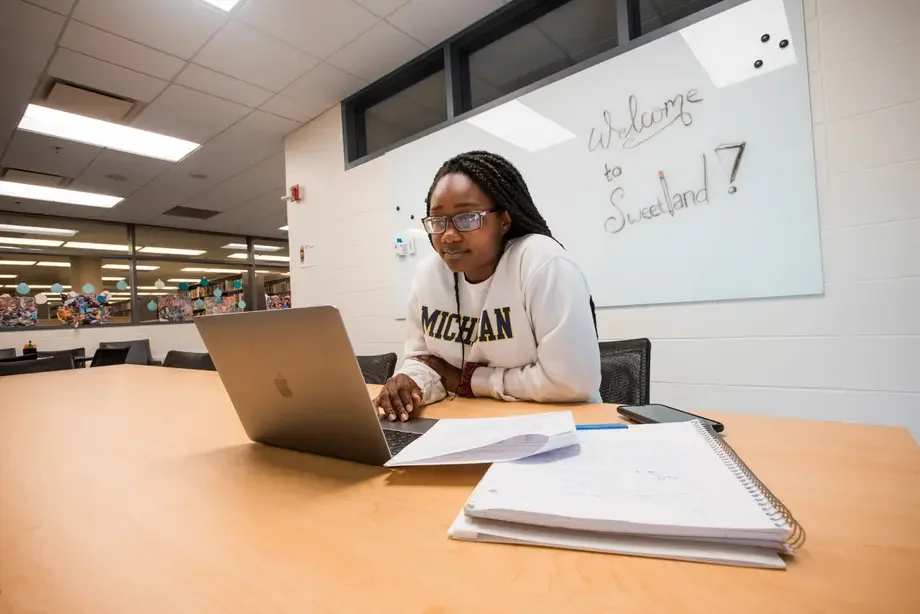
Image: Sweetland Peer Writing Center, University of Michigan Libraries.
Leadership by the Most Impacted: Accessibility Culture and the Student Advisory Board at the Sweetland Center for Writing
Torre Puckett
University of Tennessee, Knoxville
tpucket6@utk.edu
With Tess Carichner, Eli Friedstrom, Laine Kibler, Maeve Waugh
University of Michigan
Abstract
This article features interviews with four members of the Student Advisory Board at the University of Michigan’s Sweetland Center for Writing, which is composed of disabled students and convened to advise on the ongoing access improvement initiative. In addition to providing practical steps for access improvements and suggestions for convening a student advisory board at your writing center, the interviews suggest that the benefits of a student advisory board extend beyond the access improvements themselves. The existence and administration of a Student Advisory Board can create profound cultural shifts in the writing center by modeling what it looks like to expect disabled bodyminds and value disabled insight in academic-creative spaces. The experience of the board members suggests that this valuing of disabled insight provides affirming access experiences, which can translate into more positive disability identification and more confident future self-advocacy. This, in turn, can result in empowerment for disabled consultees that extends far beyond the space of the consultation.
Keywords: disability, accessibility culture, self-advocacy, Universal Design for Learning, student advisory board
Introduction
Since the University of Michigan’s Sweetland Center for Writing undertook an accessibility improvement project beginning in summer 2022, we have taken seriously the call by disability justice organization Sins Invalid for “leadership by the most impacted.” Too often, supposed “advancements” in accessibility are made without consulting disabled stakeholders, rendering the changes unhelpful or even harmful (the stair-climbing wheelchair no disabled person ever asked for comes to mind!). As such, the leaders of this project prioritized centering disabled voices from our earliest planning stages.
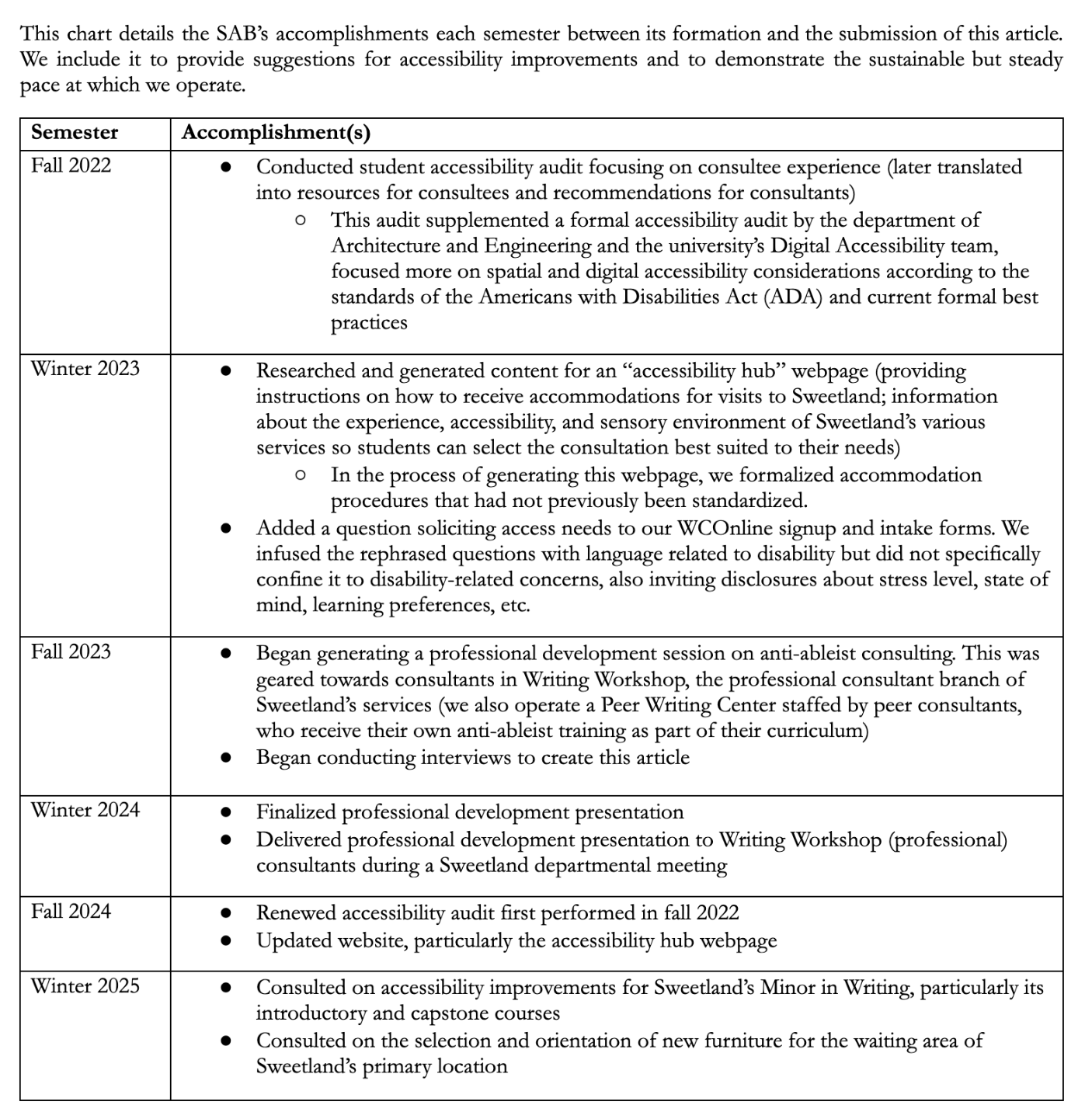
At our writing center, we have solicited guidance from disabled stakeholders primarily through our Student Advisory Board (SAB). This board is composed of disabled students who contribute expertise cultivated through their lived experience, knowledge of disability community, and practice with accessibility activism to 1) guide the implementation of planned accessibility improvements, including providing disability-informed insights on proposed plans, generating internal accessibility trainings and materials for public circulation, etc; and 2) suggest avenues for future accessibility improvements (for example, the accessibility page on Sweetland’s website was entirely the SAB’s conception and creation). The appendix provides a breakdown of our accomplishments each semester between the SAB’s formation and the submission of this article, demonstrating both the consistent, impactful changes we have made and the sustainable pace at which we have operated. Sweetland has now established the SAB as a permanent organ to ensure that access improvements remain an ongoing process, responsive to changes in culture, technology, and best practices of writing instruction.
The body of this article consists of syntheses of interviews I (Torre Puckett) held with SAB members for the academic year 2023-2024. These interviews made it clear that the value of the board goes beyond merely furnishing advice—rather, an advisory board centered on disability has the potential to create more profound shifts in writing center culture, modeling what it looks like to expect disabled bodyminds and value disabled insight in academic-creative spaces. It demonstrates the empowering effects that anti-ableist spaces have on those who inhabit them, disabled and nondisabled alike, making the SAB itself a microcosm of the accessibility culture we hope to instill in the writing center at large. It is our hope that these syntheses will encourage other writing center leaders to establish a student advisory board to support their own accessibility improvements.
As context for what follows, readers may find it helpful to know that, after extensive research on the topic, Sweetland adopted a philosophy of accessibility that incorporates both Universal Design for Learning (UDL)-based and individual accommodations-based access policies. UDL seeks to create as accessible an environment as possible for the largest number of people (the disabled, the elderly or very young, those with different learning styles, etc). UDL has been suggested as an alternative to accommodations dispensed on an individual basis. This practice, while common, problematically demands disclosure and formal diagnosis in exchange for accommodations. Students may be resistant to disclosure because of prior negative experiences with access-seeking, turning disclosure decisions into a form of risk management in which the need for accommodation must be weighed carefully against the possibility of “stigma, judgment, denial of access, and/or exposure to discriminatory and hurtful rhetorics of ableism” (Wood 85). As Elizabeth Kleinfeld astutely points out, the accommodations model can also “place financial costs on a student who may not be able to afford the medical tests and consultations that might need to happen to get the medical documentation” (para. 10). Further, as Kerri Rinaldi has argued, the demand for disclosure posits the consultant, rather than the disabled consultee themselves, as the most knowledgeable party regarding the consultee’s own disability, suggesting that only once a disability is known will the consultant be able to respond to the student appropriately based on “their knowledge bank of how to tutor that disability” (para. 18).
However, there are troubling deficiencies in the UDL model as well, such as Jay Dolmage’s concern that checklists of UDL best practices “invite us to believe that Universal Design would stop if the boxes were all checked” (“Universal Design”). Given the infinite and ever-shifting diversity of embodiments and experiences, no checklist can possibly anticipate every access need before it appears. True universality is rendered even more unachievable by the fact that access needs can contradict one another; for example, when Sweetland’s Peer Writing Center replaced harsh fluorescent lighting with gentler lamplight, the change was welcomed by neurodiverse folks and those with migraines, but it presented a substantial access barrier for an SAB member with a visual impairment during our fall 2024 access audit.
At Sweetland, we employ UDL and accommodations models simultaneously in the hopes that the strengths of each model can help mitigate the deficiencies of the other. We create more UDL-informed spaces and practices while leaving a door open for accommodations-seeking and disclosure on the students’ own terms (for example, the accessibility question on our intake form invites students to indicate accommodation needs rather than a diagnosis, though of course students are welcome to disclose if they wish). This is, we believe, the most ethical course to ensure that no student’s needs fall through the cracks either because of hesitance to disclose or because they are not served by our “universal” design choices.
Our SAB has historically been quite neurodiverse, with a wide spectrum of diagnosis statuses and fields of study, which helps represent our student population at large. However, we encountered more difficulty recruiting students with physical disabilities, male-identifying students, and graduate students. As will be discussed later in this article, we are aware that the perspectives represented on the board hold strong influence over our outputs; since Sweetland has established the SAB as a permanent organ, we are committed to recruiting diverse perspectives and look forward to the insights of future iterations of the board.
What follows are syntheses of the interviews I (Torre) conducted with four SAB members. Since I regrettably do not have the space to examine each interview in full detail, for each I have highlighted and analyzed a theme or themes I considered to be either essential to the member’s philosophy of access or particularly illuminative of the ethical imperatives or practical realities of our access improvement process. Each synthesis is followed by a short response from the interviewee, which may address their own interview or their responses to their fellow members’ interviews.
In our interviews, these four questions (generated by the members themselves) were posed:
What motivated you to join the student advisory board?
What would you identify as some major themes that were often revisited during the work of the student advisory board (ie., problems identified, values centered, or solutions promoted)? What values or action items do you hope other writing centers might take away from the work you have done with the advisory board?
How do you believe the composition of the advisory board, as a community of disabled people convened for disability justice work, affected the quality of the work and the results achieved?
How did your efforts to raise awareness of and accessibility for disabled students in the Sweetland Center for Writing inform your personal growth as a disabled student and tutor? How do you foresee this experience affecting your future academics, jobs, collaborative projects, etc.?
Readers will find that amidst—indeed, inextricable from—the members’ meditations on the work of the SAB are their lived experiences as disabled people. Many members describe serving on the SAB as a major source of confidence in, and more mature conceptions of, their disabled identity. While it is not necessarily the aim of the SAB to afford personal growth opportunities to its members, the consistency with which the members described the SAB as impacting their personal experience of disability suggests that 1) the wellbeing of disabled consultees and disabled consultants/staff (including the SAB members) are two sides of the same coin, and 2) the empowering effects of positive access and self-advocacy experiences can extend beyond the consultation to have lasting effects on positive identification with disability and future access outcomes. By creating accessible writing centers, we have the potential to empower disabled students to succeed in future self-advocacy efforts.
Interview 1: Tess Carichner, Nursing
When reading Tess’ asynchronous interview responses, I was drawn by the repeated recurrence of a theme that she termed “accessible processes, not just accessible outcomes.” In her responses, reflections on the accommodations she received as a member of the SAB intermingle with discussions of the better accommodation systems the SAB sought to create, suggesting that for her, the process by which we arrive at greater accessibility is just as crucial as the outcomes achieved. She calls accessibility “not simply something to achieve, but a continuous process that must be present in all spheres of design” and points out that “accessible pedagogy and mindsets are imperative for creating accessible policies and processes that live on past the current Advisory Board.”
Our practice of accessible processes is important partly for the sake of the immediate access needs of a board full of disabled members. Since the call for applications specified that applicants to the SAB should identify as having a disability, facilitators were not only prepared but expecting to make accommodations for the members—for instance, offering the ability to conduct interviews for this article both synchronously and asynchronously according to the member’s choice, or consistently checking in about meeting modality preference. However, practicing accessible processes in the SAB is also significant for the way it anticipates and pre-enacts the accessible outcomes that we were working towards. As Tess writes of this mindset, “Sometimes including accommodations in the process makes things take longer. We knew that the number one focus was not how fast we could complete the project, but how considerate and equitable we could be in the design of a more accessible writing center.” In Tess’ writing, the SAB itself appears as a microcosm of the environment that we are attempting to generate at Sweetland: an intellectual context where disability is always anticipated, and where the resource investment required to be considerate and equitable is undertaken gladly.
As well as prioritizing sustained rather than static changes, this focus on process helps honor the labor of the disabled individuals contributing their expertise to that process. Amongst the members interviewed, Tess strikes me as the one with the strongest bent towards organized activism, and as such, she displays a deep awareness of labor performed by disabled people to create a better world for themselves to live in. Annika Konrad coined the term access fatigue to refer to “the everyday pattern of constantly needing to help others participate in access, a demand so taxing and so relentless that, at times, it makes access simply not worth the effort” (180). Access fatigue generally refers to the experience of individuals fighting for their own needs, but Tess describes a corresponding experience of what might be called justice fatigue in advocates: “Many times, disabled people are doing immense amounts of free accessibility consulting and labor in order to promote accessibility in a space.” This extra layer of fatigue beyond that accrued by self-advocacy, coupled with the discouragement all too familiar in ableist environments, “have the ability to stop advocates in their tracks.” In the face of that kind of heartsickness, for the writing center to actively and earnestly come alongside disability advocates in their justice work can be extremely powerful: “My hope is strengthened through experiences such as the SAB, where there are faculty, staff, and students who are focused on making dreams of accessibility a reality.”
A concrete takeaway I might suggest based on Tess’ interview is this: administrators interested in convening their own SAB can consider the experience not only as an opportunity to learn how create a more accessible environment in their writing center from those most qualified to tell them, but also as a glimpse of what that more accessible writing center might look like. As such, it might be valuable to invite several writing center administrators or consultants to be involved in SAB affairs both to include them in planning and to immerse them in an environment built to be as accessible as possible.
To close my reflections on Tess’ interview, I would like to leave you with her words as a reminder of why accessibility efforts in the writing center matter: “Personally, I feel that skill in writing has been an integral part of my ability to contribute to disability culture, community, and justice. I want disabled students to have writing resources for their academic success, but also because disabled voices are paramount to our progression towards equity.” The stakes of disabled access to writing skill and support do not end with the consultation, or even the classroom—it is a tool that helps the disability community make lasting advances towards justice and equity.
Response to Interview 1, by Tess Carichner
As we communally reflect on our work, I began to see how we have subverted experiences of academic ableism, and morphed them into strategies to prevent those experiences from happening to other disabled kin. As you will read later on, Laine communicates about how their intrusive thoughts became of new use while completing access consultant work. Eli discussed how access to education changed drastically upon transitioning to UofM. Maeve’s section touches on the ideas of work and worth, which is strongly tied to the American conceptualization of disability. Maeve says, “You can’t focus as much on what you’re good at when you’re also focusing on being socially acceptable.” When utilizing accommodations with any sort of ease, I remember it was not always this way. When frustrated with issues of ableism that remain, I remind myself of the words of three disability justice leaders (Ho, Mingus, and Wong): “Access is Love” (“Access is Love”). The access I have now is because of the love worked into existence by disabled elders and ancestors. While our SAB lacks members who can contribute expertise related to being BIPOC, physically disabled, and/or non-speaking, it is made up of people from multiple majors, stages in their degrees, educational backgrounds, and (to an extent) types of disabilities. To make this love more substantial and all-encompassing, SABs that reflect the many intersectional identities of disabled people can be created and nurtured. My hope is that the work we do as a SAB contributes to the greater work of this disabled generation, in passing down more access to our descendants.
Interview 2: Maeve Waugh, Classical Archaeology & Film Production
Maeve’s interview dwelt upon the relations between access, productivity, leadership, and success. She described resistance she previously felt to claiming the label of disability because she did not feel that her (primarily social) disability was interfering with her work: “I don’t get to take on the name of disabled unless… my work is inhibited by my mental illness.” This difficulty disentangling the notions of work and disability is all too familiar to anyone trying to make a living while disabled. Lennard Davis goes so far as to argue that since the mid-nineteenth century, disability has come to be defined primarily by a person’s “relation to means of production or a productive economy” (73-74). By this definition, only once a difference begins to impact work does it actually become a disability, and as soon as it impacts work, disability must be healed, managed, or expelled. As Tanya Titchkosky writes, “body stuff”—not just disability, but “catching a cold, falling off your bike, menstruation, sleepless nights, hot flashes, desires”—“needs to all but disappear for the work of bureaucratic structures to be achieved” (123).
As Maeve has entered professional worlds that come with a stronger social component, she has come to find disability affecting her work life more strongly than it ever had before. In collaborative work environments, Maeve—mirroring the experience of many disabled consultees—finds her attention torn between “keep[ing] the mask on” and successfully executing the task at hand. Here, Maeve refers to “masking,” a practice that requires mimicking neurotypical behaviors and suppressing tics, stims, or other behaviors that may be natural to the neurodivergent person but are considered inappropriate by neurotypical society. The mental demands of masking often lead to exhaustion, heightened stress, overwhelm, impaired function, lower tolerance to stimuli, and even mental illness and “autistic burnout” (Raymaker). However, refusal or inability to mask is often punished by adverse consequences, including social ostracization, academic or career penalties, and even institutionalization, meaning that neurodivergent folks are often heavily socialized into the practice of masking.
Maeve and I discussed the double bind in which disabled people are almost never invited to disclose their disabled identity, much less in warm and welcoming ways that make them feel safe unmasking, but are met with bewilderment, discomfort, and even alienation when symptoms of that disability catch people unawares. Essentially, disabled people are implicitly compelled to “pass” as able-bodied as they possibly can, as successfully as possible, until the toll of energy and attention this demands grows too costly—and when this crisis point is reached, either the mask they wear must drop or the task at hand must fail, or both. This leaves disabled people juggling competing imperatives, a sideshow that reroutes needed focus and energy from the task at hand. Maeve puts it in powerful terms: “You can’t focus as much on what you’re good at when you’re also focusing on being socially acceptable.”
This kind of pressure to be well in addition to doing well can sometimes be overwhelming, especially in spaces like the writing consultation. In consultation, students attempt a potentially uncomfortable and challenging academic task within what Margaret Price might term a kairotic space—“the less formal, often unnoticed, areas of academe where knowledge is produced and power is exchanged,” where stakes may feel unexpectedly high and expectations not explicitly articulated (60). In the most heartfelt segment of my interview with Maeve, we discussed the value of “places where people can be allowed to continue working and trying their best” if they do have outbursts, anxiety, shutdowns, or other disabled reactions that, in most spaces, might threaten to alienate others or “get in the way” of academic or professional success.
While it’s unlikely that students will be able to easily drop masking behavior so ingrained that it may have become difficult for them to recognize it as masking at all (“#TakeTheMaskOff”), we should be doing our best to create spaces where acting neurotypically is not a requirement for success. Of course, the physical and emotional safety of consultants must always be kept paramount in the rare cases where they may be threatened by an outburst from a student, but we must learn not to categorize our own discomfort or confusion in the space of consultation as a disqualification for the student. Welcoming students’ true selves, not just their able-bodied masks, into consultation may be as simple as offering a consultee a fidget toy, a five-minute break, or a sincere compliment, or as fundamental as revising the basic metrics of success for a consultation—perhaps today, that means getting words on the page without crying, or perhaps it means getting words on the page through the tears. With these gentle acts, we can make room for students to do what they’re good at without the additional drain of masking or passing, and to grow without fear of the failures that pave the way to every breakthrough.
Response to Interview 2, by Maeve Waugh
I found that my interview section dealt with the difficulties of balancing work, disability, and identity as a college student, as well as how one’s disability “status” is often gauged by how well a person can fit into neurotypical society. This is most often measured by how well a student can complete the tasks assigned to them without assistance, but this is not entirely where the difficulties of living with a disability—or the commonly recognized needs for accommodations—reside. Sometimes, making accommodations means helping people complete tasks that are difficult for them because of their disability, and sometimes accommodation means assisting people outside of their “productive task” day to day, often emotionally or mentally. One may argue that it isn’t the place for a writing center to offer this extra level of accommodation and inclusion because these people on the edges may not “need it,” but I can speak from experience and say that when I see teachers and counselors utilize meta-consulting [1] to reduce rejection anxiety, or offer fidget toys in the consultation room, or generally offer alternatives to reading aloud or eye contact, I feel welcomed and acknowledged and seen in a way that I usually don’t as a low-support-needs autistic person, which not only helps my academics but also my self-confidence as a person. Often, neurodivergent folks who do well in school but struggle socially are looked over as they seem to be “doing fine,” as their success is only being measured by a report card rather than how fulfilled or safe they feel in the moment. But success in life is defined by much more than productivity in work or success in education, and we have discussed how we want the writing center to provide accommodations to students with an individualized understanding of the needs of people who come into the writing center. By this I mean that we don’t follow the “independent reader/writer” standard of success as is usually pushed in public schools but rather work with the student and the tools at their disposal—whether that be text-to-speech, spellcheck, Google, writing templates, or whatever they may need to finish their writing project—in order to create a successful student by means of bolstering their own self-confidence in writing and as meets the standards of the University of Michigan.
Interview 3: Eli Friedstrom, Neuroscience & Cognitive Science, Linguistics Concentration
Eli’s neurodivergence did not become apparent until later in life. They attended a private Christian school for their entire K12 education, which provided such a highly personalized and supportive environment that the need for educational accommodations never materialized. However, at the University of Michigan, where the environment is much more “catered to the average intelligent person,” their need for accommodations soon emerged as a factor. Although Eli has come to embrace their neurodivergent identity since starting college, they have no interest in pursuing a formal diagnosis—in their words, “that’s not going to aid me in any way, it’s only going to hinder me because of how stigmatized it is.” They prefer to retain control over the labels they use in different situations, a versatility that a formal diagnosis might limit.
Perhaps because of these experiences, a theme of disability as a flexible and circumstantially determined location on a spectrum emerged through the course of my interview with Eli. This manifested partly through their interest in Universal Design (UD) and Universal Design for Learning (UDL). Eli sees these as tools to “incorporate the needs of disabled people in a way that is not centering on them and otherwise Othering them.” For Eli, in concentrating our efforts on disabled people, we must be wary of a tendency to reify old and flawed methods of targeting the disabled individual as the site of intervention, marking bodyminds as the problem instead of a disabling and discriminatory system at large. As they put it succinctly, that would make the SAB “just the accommodations board.” Eli prefers an approach that “is for everyone, and by making it with disabled people in mind it helps everyone.” They point out that anyone can embody disability, even if only for the duration of healing from a broken leg or a concussion. Eli says that this is why accommodations need “to be marketed towards the average person…this can be for you too. This can be you too.”
Eli’s awareness of non-disabled stakeholders in disability justice also manifested as a concern for how our work will be understood and received, a concern at least partly motivated by the pushback they routinely encounter against their queer advocacy. “When you get into microidentities,” they said grimly, “that’s where you kind of lose people.” Like so many advocates before them, Eli is wrestling with some of the most difficult and crucial questions of practical justice work: how to normalize difference without minimizing the unique challenges of marginalized existences, and how to negotiate between the need to educate and the risk of alienation when attempting to connect with prospective allies who might balk at too much information or too much pressure. Referring to our work generating a training for writing consultants on disability, they cannily point out that a board of students who not only hold pro-disability perspectives but live disability every day might have a hard time assuming the perspective of someone less familiar with disability or justice work in order to meet that person’s educational needs. The type of disabilities represented on the board “could influence the type of work we put out, and make it not generalizable.” Eli points out that our strengths in neurodiverse perspectives have surely influenced how we have chosen to focus our teaching and advocacy (at the time of this interview we lacked perspective on the experience of physical disability, though we have successfully increased our representation of diverse impairments in subsequent iterations of the SAB). They remind us not to forget—mired as we are within our own viewpoints, passions, and ideologies—the value of works and perspectives that are important to others, or the importance of making sure that those who will implement our recommendations truly believe that the changes matter. The goal is not just to make changes to policies and spaces, but to mindsets, attitudes, and instincts, and this means that, just as much as nondisabled perspectives we do not share, we cannot afford to disregard the nondisabled perspective while pursuing accessibility advocacy.
Eli admitted that so much attention to nondisabled interests wasn’t quite “what you want to hear from a disability justice or advocacy board.” However, they still find such attention necessary: “Ultimately we are trying to break down the barriers that bar us from having these experiences that are similar to neurotypical people or nondisabled people … but for the time being until those bars are actually broken, we have to operate within that system and within the framework that not everyone understands or is as accepting.” As galling and daunting as it can be to admit the difficulty of remaking our mindsets and our institutions, Eli is right to point out that resistance is real, resources are limited, and minds do not change easily or quickly. It is best to know your freedoms and constraints (in terms of budget, time, investment by individuals, and culture) so that you can create the most accessible environment possible within them. Work with what you have right now, and wait and advocate for more to come.
Response to Interview 3, by Eli Friedstrom
Disability advocacy has been a cornerstone of my life since I began to understand the concept of “disabled,” and has roots in all of my experiences and connections. Being on this advisory board where a group of disabled students are able to do disability advocacy with tangible results has been incredibly special. This experience has not only allowed me to further understand myself and how I operate within a larger system, but through understanding different models of accommodations I have found myself being able to better understand the world around me and better able to extend this notion and empathy to others. Tess mentions that the board is a “microcosm of the environment we are attempting to generate for Sweetland as an institution,” and my time on the board now informs my perspective of the world at large. I have implemented what I have learned as a part of the SAB in my job through accessible interviewing practices and training formats, my research in working with bilingualism, my position as a community support specialist for other disabled individuals, and my own actions and the way I treat myself. Access is important for everyone, and the more able and comfortable we are to provide means of access the more able and comfortable others will be to ask. I know that our work so far has just been the beginning and I am hoping that through our success our university will be able to recognize our importance to both the writing center and the university at large, which in the future will promote more disability advocacy positions and spaces.
Interview 4: Laine Kibler, Creative Writing & Film Photography
As a consultant in Sweetland’s Peer Writing Center, Laine contributes a unique perspective to the SAB. When convening your own SAB, we highly recommend extending an invitation to existing consultants and consultants-in-training, asking that any interested disabled consultants apply; Laine has brought an invaluable perspective through their consulting experience and familiarity with Sweetland’s pedagogy from the consultant side. As such, Laine has helped highlight deficiencies in consulting practice from the perspective of someone who understands the pedagogical and practical reasons for many misfits between standard consultation practice and the needs of disabled students. As they write, “That was interesting because not only was I critiquing the accessibility of my own workplace, but I was being affected by the inaccessibility of it daily as an employee.”
Laine also reminded us that disability exists in all facets of the writing center, among our faculty and employees as well as our consultees. This has been a critical corrective to a tendency we might otherwise have had to focus our accessibility improvements only towards consultees, reifying what Tanya Titchkosky refers to as disability’s “absent presence.” In a reductive binary, this absent presence assumes disability will only be “partially included, for example, for those who may be receiving an education but not for those who administer or deliver education” (99). The mindset that those in teaching and leadership positions must necessarily be able-bodied and self-sufficient is damaging, and also reinforces a hierarchy between consultant and consultee that the peer consulting model in particular aims to minimize.
Working with the SAB has also affected Laine’s practice as a writing center employee. This has taken some concrete forms in consultation: “for example, I now hesitate to show students anything on my personal laptop screen in case they use screen readers or other access softwares on their technology that I don’t have … I try to ask students questions relating to their interests and opinions about coursework in brainstorming questions because it’s especially key to work around these things with neurodivergent students that can struggle to focus on uninteresting subjects.” It has also affected their behavior on the administrative and collegial side of their writing center work. Firstly, they are now more comfortable with self-advocacy as an employee and take proactive steps to address inequitable conditions for themselves and other disabled consultants. They write, “If I am finding myself at an unreasonable disadvantage compared to able-bodied or able-minded consultants, I can remedy the situation myself or reach out for help from my coworkers and administrators.” Secondly, it has given them a “designated time or area in [their] already quite full schedule to make those changes happen.” Improving their workspace for their consultees and fellow consultants was not always in Laine’s job description, but now that they are part of the SAB, it is. Now, they are not only requested but paid to designate time in their schedule for this task. Lastly, as they wrote, “this work… has allowed me to feel that openness about my daily struggles is helpful and important to the deconstruction of ableist academic structures (such as some aspects of writing center ideology).” Laine has not just become more comfortable being open about their challenges for the sake of their own access, but sees this openness as contributing to a larger justice effort in the writing center and the university at large.
I found Laine’s explanation why we must convene disabled people to do disability justice work extremely compelling and insightful. They wrote, “The mixture and variety of all of our experiences allowed us to think bigger about not only what the problems could be, but the various solutions to those problems that writing centers could implement.” To me, this suggests that the existing and intuitive familiarity with the challenges of disabled living which exists in the SAB allows us to look beyond those challenges to solutions; in a group of disabled people familiar with the shortcomings of the world we live in (which Eli has helpfully reminded us not to be naïve about) we need not waste much time retracing the shape of those shortcomings. Instead, we can skip straight to envisioning—and then making—a better world.
Response to Interview 4, by Laine Kibler
As I’ve moved out of the higher education sphere following my graduation from UM, I’ve begun to enter the “real world” and reflect on what the SAB meant to me during the latter half of my college experience. This advisory board has been the most special place—which also happened to be a professional setting—that I’ve ever existed in. Rather than being bogged down by my rampant and constant obsessive thoughts and mental compulsions, they became crucially beneficial to the work I was doing. I was achieving a level of mindfulness and calm in this job that I struggle to find in my personal life, let alone in a professional setting, making me question the label of my OCD as a “disability” in the first place.
Reading through my coworker’s interviews with Torre, I was moved by Tess’s notion of the advisory board as a microcosm of what we were trying to accomplish in the institution of Sweetland. This comment hones in on how this board can be proof of a society’s ability to disable people more than their born bodymind. [2] It is extremely difficult to find work comparable to this, where my weaknesses in a neurotypical world instead become strengths, and rather than feeling out of place, I am precisely who I “should be” in every given moment. All institutions need to make space for this work, not just writing centers; room for marginalized identities to cocreate and coexist not only allows us to commiserate self-indulgently, but simultaneously allows us to make a better world. In summary, I feel that this work is so crucial because within it, rather than our human value being determined by one’s productivity, we, as disabled individuals, can have value by “merely existing,” as Torre stated in her writing about our interview. When my mere presence functioned as a reminder that disabled employees must also be accommodated, I contained value as a person without “producing” the way society would traditionally demand of me.
Conclusion
Institutions can balk at the work of improving access because the task seems daunting and unachievable, and downright inelegant besides. The awkwardness of repairing inaccessibility is well-illustrated by the concept of the retrofit, when a device nominally intended to improve access, like a ramp or elevator, is tacked onto a physical space that was not built with it in mind. The result is often not only awkward, ungainly, and ludicrously expensive—according to Jay Dolmage, retrofits are borderline “passive aggressive,” as though a visible, tactile sign of blame that disabled people dare to have access needs, or as though marking the disabled person forced to use them with stigma, ultimately serving to “preserve or perpetuate exclusion rather than address it” (Academic Ableism 77, 76). There is simply no retroactive addition of accessibility features that will match the unitary wholeness of a construction that, from its inception, was created with disability in mind. The writing center is also an edifice that was not constructed with disability in mind, as are practically every educational institution and value—but writing centers can also be one of the most beneficial institutions on campus to support academic success for students with disabilities. An SAB can support this work by modeling a writing center institution that requires no retrofit, built with disability in mind from the ground up; better yet, its input can ensure that the programs and policies you implement in the future can also be retrofit-free.
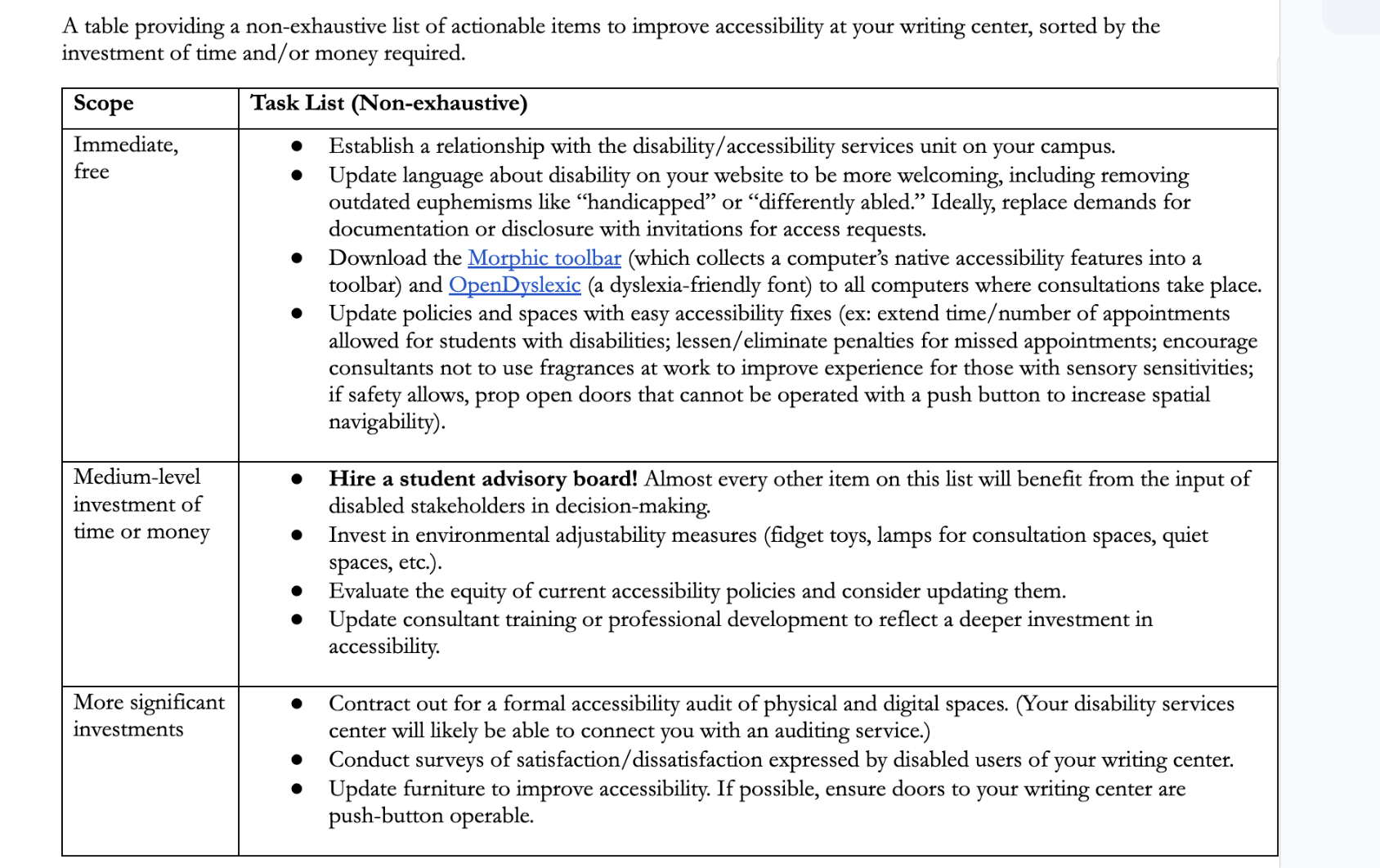
As theorists and practitioners of UDL tell us, the most feasible and sustainable way to implement changes is by the “plus one approach;” by implementing and acclimating to one or a handful of achievable changes at a time, and repeating this process continually, you will continue approaching ever closer to universality (Tobin and Behling 134). Appendix B provides a non-exhaustive list of action items that can add up to substantial increases in accessibility, implemented one at a time as they become achievable.
For those interested in forming their own SABs, here is some logistical information on ours to get you started. Our members were recruited by circulating a flyer through our disability services center, amongst instructors teaching courses on disability, and amongst our peer writing consultants. From these options, we have had the most success with professors recommending their students apply to the SAB and through word-of-mouth recruitment by current SAB members. Our members are hired at a competitive hourly wage for a commitment of one year, but we have enjoyed an excellent retention rate, with a high proportion of students renewing their membership until their graduation. The SAB’s demands on our budget have been relatively low despite the competitive hourly wage the students are paid (which, as all four interviews indicated, the students understand as a mark of our appreciation for their work and genuine investment in accessibility improvement) because the activities undertaken mostly demanded a low time commitment. I found that, at a pace of one or two accessibility goals per semester—usually chosen by the director and the graduate student facilitator, with the input of SAB members over the course of the semester often informing the plans for the subsequent semester or year—student labor tended to amount to only about 7-10 hours per semester per student (see Appendix B for some of the accessibility goals we have accomplished since the SAB’s founding). Our board typically consists of three to four students along with the graduate student facilitator; with more students, it became difficult or impossible to schedule meetings where all members could attend, and we have historically prioritized the ability to meet with all members rather than a higher number of members that could not consistently contribute.
Investing in a SAB yields high-impact results, particularly in its early semesters, when there is the most room for accessibility improvement. Many of our SAB’s contributions have cost nothing beyond the time it took for them to generate recommendations or materials (such as the training they deliver to consultants, materials they generate, web access recommendations, and clearer/more effective/more equitable accessibility policies). Other recommendations have resulted in low-cost, high-impact investments like lamps to create adjustable lighting options and fidget toys for each Sweetland location. Most recently, the SAB provided feedback on the new furniture Sweetland purchased for a waiting area and the configuration for that furniture, helping to ensure this substantial investment would be an access solution rather than an access problem to be solved in the future—a retrofit rendered unnecessary. There is no denying that accessibility improvement measures sometimes require a substantial investment of money, time, and other resources, but we have found that an SAB is not only a relatively affordable investment, but one that can help ensure the most effective implementation of what resources you have available.
Even if our writing centers cannot be entirely free of retrofits, we can from now on take seriously Annika Konrad’s call to “use access as a lens for all that we do in writing programs” (“Access as a Lens”). This is not to say that a non-retrofitted object like the SAB will always run with effortless smoothness, or even that it will require no accessibility upgrades in the future; as Tess pointed out early on, the accessible processes involved in our SAB sometimes cost us extra time, effort, and advance planning. However, in these lean times for both writing centers and equity initiatives, avoiding ungainly retrofits is all but imperative. We can either pay up front for a more efficient and effective result (demonstrating our earnest investment in serving disabled community members in the bargain), pay later for an inevitably clumsier and likely costlier retrofit, or alienate entirely a community whose presence in the writing center is of great mutual benefit. The experience we have had with our SAB not only demonstrates just how different a space generated with disability in mind from the start feels to disabled people, but how it can help create spaces, policies, and cultures that do not require retrofits in the future. With disabled stakeholders involved in the process of creating new policies, physical environments, and programs, we can begin to do things right more often than we must do things over.
Endnotes
By “meta-consulting,” Maeve refers to the practice of explicitly narrating the reasoning behind consulting suggestions as they are offered. This helps demystify the suggestions for consultees and de-hierarchize access to information in the consultation space.
Laine refers to the social model of disability, which (in contrast to the medical model, which understands disability as located solely in the body) recognizes disability as socially constructed. To cite a helpful and common example, if all buildings used elevators instead of stairs, wheelchair users would not encounter issues using stairs—in this case, the built environment has disabled someone who could navigate easily in a one-story or elevator-equipped building.
Works Cited
“Access is Love.” Disability Intersectionality Summit, https://www.disabilityintersectionalitysummit.com/access-is-love.
Brooke, Collin and Alison Carr. “Failure Can Be an Important Part of Writing Development.” Naming What We Know, Classroom Edition: Threshold Concepts of Writing Studies, edited by Linda Adler-Kassner and Elizabeth Wardle, University Press of Colorado, 2016, pp. 62–64.
Davis, Lennard. “Nationalism and Deafness: The Nineteenth Century.” Enforcing Normalcy: Disability, Deafness, and the Body, University of Michigan Press, 1995, pp. 73–99.
Dolmage, Jay Timothy. “The Retrofit.” Academic Ableism: Disability and Higher Education. University of Michigan Press, 2017, pp. 67–98.
—. “Universal Design: Places to Start.” Disability Studies Quarterly, vol. 35, no. 2, 2015, https://dsq-sds.org/index.php/dsq/article/view/4632/3946. Accessed 26 June 2024.
Herzl-Betz, Rachel et al. “Modeling Accessibility: Perspectives from the Accessibility Task Force.” WLN: A Journal of Writing Center Scholarship, vol. 47, no. 4, pp. 3–14.
Konrad, Annika. “Access as a Lens for Peer Tutoring.” Another Word: From the Writing Center at the University of Wisconsin at Madison. 22 February, 2016. https://dept.writing.wisc.edu/blog/access-as-a-lens-for-peer-tutoring/. Accessed 28 June 2024.
—. “Access Fatigue: The Rhetorical Work of Disability in Everyday Life.” College English, vol. 83, no. 3, 2021, pp. 179–199.
Kleinfeld, Elizabeth. “Taking an Expansive View of Accessibility: The Writing Center at Metropolitan State University of Denver.” Composition Forum, vol. 39, 2018, https://compositionforum.com/issue/39/msu-denver.php.
Titchkosky, Tanya. The Question of Access: Disability, Space, Meaning. University of Toronto Press, 2011.
Raymaker, Dora. “Understanding autistic burnout.” National Autistic Society, 1 March 2022. https://www.autism.org.uk/advice-and-guidance/professional-practice/autistic-burnout.
Results of the 2021 University of Michigan Student Campus Climate Survey on Diversity, Equity, and Inclusion. University of Michigan Office of Diversity, Equity, and Inclusion. 2021.
Rinaldi, Kerri. “Disability in the Writing Center: A New Approach (That’s Not So New).” Praxis: A Writing Center Journal, vol. 13, no. 1, 2015, http://www.praxisuwc.com/rinaldi-131.
Sins Invalid. “10 Principles of Disability Justice.” Sins Invalid, 15 September 2017, https://www.sinsinvalid.org/blog/10-principles-of-disability-justice.
Tobin, Tom J. and Kristen T. Behling. “Adopt the Plus-One Approach.” Reach Everyone, Teach Everyone: Universal Design for Learning in Higher Education. West Virginia University Press, 2018, pp. 128–140.
Wood, Tara. “Rhetorical Disclosures: The Stakes of Disability Identity in Higher Education.” Negotiating Disability: Disclosure and Higher Education. Edited by Stephanie L. Kerschbaum, Laura T. Eisenman, and James M. Jones. University of Michigan Press, 2017.
“The UDL Guidelines.” Cast, https://udlguidelines.cast.org/.
“#TakeTheMaskOff (but What if I Don’t Know How?).” Reframing Autism, https://reframingautism.org.au/takethemaskoff-but-what-if-i-dont-know-how/.